
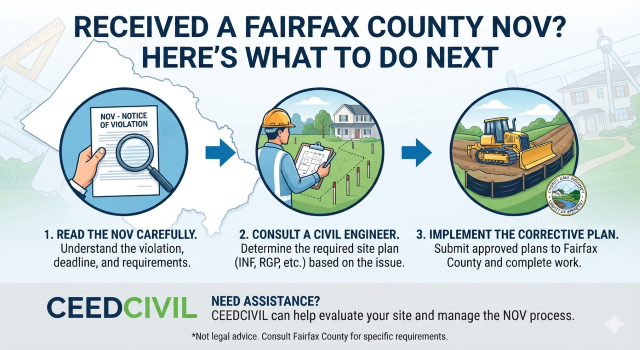
Received a fairfax county notice of violation?
Getting a Notice of Violation from Fairfax County can be stressful, especially when you’re not sure what caused the problem or what you’re expected to do next.
A Notice of Violation, commonly called an NOV, is used by Fairfax County’s Department of Code Compliance to notify a responsible party about an observed violation. The notice identifies the violation, provides information about the corrective action, and gives a timeframe for addressing it. Fairfax County also makes clear that an NOV itself is not a bill or invoice.
The important thing is not to ignore it.
What is a fairfax county notice of violation?
A Notice of Violation tells a property owner, tenant, or other responsible party that the county believes a specific requirement has not been met.
The notice generally provides information about:
- The type of violation
- Where and when the violation was observed
- The applicable code section
- The corrective action required
- The deadline or timeframe for correcting the issue
- Contact information for the responsible investigator
The details matter. Two properties may appear to have similar site issues but require completely different corrective measures.
what should you do after receiving a nov?
Start by reading the entire notice carefully.
Look for the specific violation and the corrective action identified by the county. If the notice refers to grading, drainage, land disturbance, stormwater, or another site-related issue, you may need more than a simple property maintenance correction.
This is where a civil engineering professional can help.
A site may need an appropriate plan prepared and submitted to Fairfax County to document how the violation will be corrected. Depending on the circumstances, that could involve an Infill Lot Grading Plan (INF), Rough Grading Plan (RGP), or another site-related plan.
Fairfax County’s INF requirements specifically identify Notices of Violation and Corrective Work Orders as documents that may need to be included when applicable. The county’s RGP requirements also reference NOVs and its technical guidance for site-related plans submitted to address violations.
Dont start grading work just to “fix” the problem
One common mistake is trying to correct a drainage or grading problem by moving soil before understanding what the county requires.
That can create a second problem.
The right approach is to first understand the existing site conditions, determine what caused the violation, and identify what type of plan or corrective work is appropriate.
For example, changing the grade around a house may affect where stormwater flows. A change that appears helpful from one part of the property could send runoff toward a neighboring property or create another drainage concern.
A proper site evaluation helps avoid guessing.
when an engineer maybe needed
A civil engineer or other qualified design professional may be appropriate when the violation involves:
- Grading
- Drainage
- Stormwater
- Land disturbance
- Erosion and sediment control
- Site-related construction
- Required site plans
- Infill development
- Corrective grading
The exact professional and plan requirements depend on the property and the violation.
For example, Fairfax County states that an RGP must be certified by an appropriately licensed professional, such as a professional engineer, land surveyor, architect, or landscape architect meeting the applicable requirements
Can an nov be connected to an inf or rgp?
Yes, depending on the circumstances.
Fairfax County’s INF guidance specifically provides for plans submitted to address Notices of Violation. The county’s RGP guidance likewise references NOV-related submissions.
That does not mean every NOV requires an INF or every site violation requires an RGP.
The correct plan depends on the property, the proposed work, the amount and type of land disturbance, existing approvals, and the specific county requirements applicable to the project.
Don’t Wait Until the Deadline Is Close
An NOV usually gives you a timeframe for corrective action.
Waiting until the last few days can make an already difficult situation harder. Site conditions may need to be investigated, drawings prepared, documents assembled, and plans submitted for review.
If your Fairfax County NOV involves grading or another site-development issue, getting professional help early can give you more time to understand the problem and determine the appropriate path forward.
Need help with a Fairfax County site violation, NOV, grading issue, or related civil engineering plan? CeedCivil can help evaluate the site and determine what type of engineering support may be appropriate for your situation.
Information in this article is general information, not legal advice. Fairfax County requirements should be confirmed for the specific property and project.