
rough grading plan (rgp) in fairfax county: when is one required?
If you’re planning land disturbance in Fairfax County, you’ve probably encountered the term RGP, or Rough Grading Plan.
An RGP is not simply a general grading drawing. Fairfax County has specific circumstances under which a Rough Grading Plan is required and specific limitations on what can be proposed under one.
Understanding those rules before work begins can prevent costly mistakes.
what is a rough grading plan?
A Rough Grading Plan is a site-related plan used to show proposed clearing and grading for certain projects.
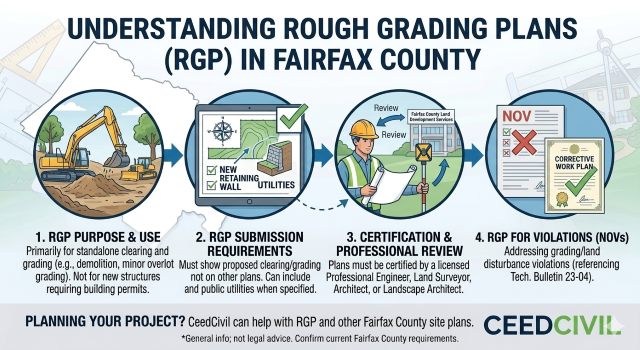
Fairfax County states that an RGP is generally required when land disturbance will exceed 2,500 square feet and the proposed clearing and grading isn’t shown on another applicable plan, such as a Site Plan, Subdivision Plan, Public Improvement Plan, Infill Lot Grading Plan, or Conservation Plan.
There are also circumstances where an RGP may be submitted before approval of a site plan or subdivision plan, subject to Fairfax County’s applicable requirements.
an rgp isn’t a shortcut for every project
This is one of the biggest points property owners should understand.
A Rough Grading Plan is generally intended for clearing and grading activities.
Fairfax County’s 2025 Technical Bulletin on RGPs explains that standalone RGP use is generally limited to activities such as demolition of existing structures and minor overlot grading. It also states that structures requiring building permits are not allowed on a standalone RGP, with an exception for retaining walls, and public utilities may not be proposed with an RGP.
So if you’re thinking about using an RGP simply because it seems easier than another plan type, stop and evaluate the project first.
The wrong plan type can lead to delays.
when might a property need an rgp?
An RGP may be appropriate when a project involves significant clearing or grading that isn’t already being addressed through another applicable site-related plan.
For example, a project involving demolition and subsequent site grading may require an RGP depending on the circumstances.
Fairfax County also allows certain RGPs to be submitted in advance of site plan or subdivision plan approval when the project meets the county’s applicable criteria.
Those situations are more specific and should be evaluated against the current county requirements.
who can prepare or certify an rgp?
Fairfax County states that landowners, developers, or authorized agents may submit an RGP, but the plan itself must be certified by an appropriately licensed professional meeting the applicable requirements.
The county identifies professional engineers, land surveyors, architects, and landscape architects among the professionals who may certify an RGP when properly licensed and qualified.
That certification is important because grading affects more than the appearance of a property.
It can affect drainage, erosion, neighboring properties, stormwater, and other site conditions.
who can prepare or certify an rgp?
Fairfax County states that landowners, developers, or authorized agents may submit an RGP, but the plan itself must be certified by an appropriately licensed professional meeting the applicable requirements.
The county identifies professional engineers, land surveyors, architects, and landscape architects among the professionals who may certify an RGP when properly licensed and qualified.
That certification is important because grading affects more than the appearance of a property.
It can affect drainage, erosion, neighboring properties, stormwater, and other site conditions.
what happens during county review?
Submitting the plan is not necessarily the final step.
Fairfax County explains that site-related submissions can be reviewed by multiple county functions, including the Site Application Center, Minimum Submission Review team, Health Department when applicable, and Site Development and Inspections Division. Applicants may receive deficiency comments and may need to submit corrections or additional documentation.
This is why preparation matters.
A plan that anticipates applicable requirements is generally easier to move through review than one that leaves important questions unanswered.
what if the rgp is related to a notice of violation?
This is another situation where the details matter.
Fairfax County’s RGP requirements specifically address Notices of Violation and Corrective Work Orders when applicable. The county also references Technical Bulletin 23-04 for RGPs submitted to address NOVs.
If your property has received an NOV involving grading or land disturbance, don’t assume an RGP is automatically the answer.
The existing violation, site conditions, proposed corrective work, and applicable county requirements all need to be considered.
Before You Start Moving Dirt
If a project involves substantial grading or clearing, it’s worth determining the required plan before equipment arrives on the property.
Starting work first and trying to document it later can create a much harder situation, particularly if the actual site conditions differ from what was originally proposed.
A civil engineering professional can help evaluate the property, identify the appropriate site-related plan, and prepare the documentation needed for the applicable review process.
If you’re planning grading, demolition, site work, or correcting a Fairfax County site violation, CeedCivil can help you determine whether an RGP or another site-related plan is appropriate.
Requirements can vary based on the project and property. Confirm current Fairfax County requirements before beginning land-disturbing activities.