
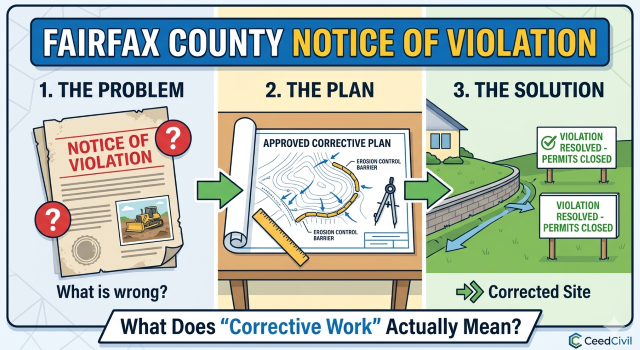
Fairfax County Notice of Violation: What Does “Corrective Work” Actually Mean?
You’ve received a Fairfax County Notice of Violation.
You read the notice and see language about correcting the violation.
But what does that actually mean?
For some property owners, the answer may be straightforward. For others, particularly when the issue involves grading, drainage, fill, erosion, or land disturbance, corrective work can require much more than simply hiring someone to fix the visible problem.
The correction has to address the actual violation.
Start With What the Notice Says
A Notice of Violation should be read carefully before any work begins.
The first question is:
What is Fairfax County saying is wrong?
Was land disturbed without approval?
Was fill placed on the property?
Were approved plans not followed?
Is there an erosion issue?
Has grading changed drainage?
The corrective action should be based on the specific violation, not on assumptions about what might satisfy the county.
Corrective Work Isn’t Always Just Construction
Suppose unauthorized grading occurred.
The solution might involve physically changing the property, but the county may also require documentation showing what exists and how the site will be corrected.
Depending on the project, that could involve a site-related plan.
Fairfax County’s INF and RGP submission requirements specifically state that Notices of Violation and Corrective Work Orders should be included when applicable.
That means the violation can become part of the plan-review process.
What Might a Corrective Plan Need to Address?
The exact requirements vary, but a site-related corrective plan may need to account for issues such as:
- Existing and proposed grading
- Drainage
- Stormwater management
- Erosion and sediment control
- Soil placement or removal
- Environmental restrictions
- Existing site conditions
- Required county documentation
The important point is that the plan should explain how the violation will actually be corrected.
Why You Shouldn’t Guess
Imagine a homeowner receives an NOV because fill was placed on the property.
The homeowner decides to remove some of the dirt.
But how much should be removed?
Where should the final grades be?
What happens to the water after the soil is removed?
Does the correction create erosion?
Could the work disturb another area of the property?
Without evaluating the site, a well-intentioned correction can create another problem.
The Plan Type Depends on the Project
Fairfax County has several types of site-related plans.
An INF may apply to certain residential projects involving more than 2,500 square feet of land disturbance and stormwater improvements.
A Conservation Plan can apply to certain residential additions and structures when the project meets its applicable disturbance and stormwater criteria.
An RGP may apply where significant clearing and grading are not shown on another applicable plan.
The violation itself doesn’t automatically determine the plan type.
The site and corrective work do.
Don’t Confuse “Fix It” With “Do Whatever Seems Reasonable”
This is where property owners can lose time.
The goal is not simply to make a visible condition disappear.
If the issue involves regulated grading or land disturbance, the correction may need to comply with Fairfax County’s current erosion and stormwater requirements.
The county’s ordinance requires applicable land-disturbing activities of 2,500 square feet or more to provide erosion and sediment control, water quantity control, and water quality control.
The Best First Step
If you’ve received an NOV involving a site-development issue, gather the information before starting corrective work.
Review:
- The Notice of Violation
- Any approved plans
- Existing surveys or plats
- Previous permits
- Photos of the current site
- Information about work already performed
Then evaluate what the county requires to resolve the issue.
If you have received a Fairfax County NOV involving grading, drainage, fill, land disturbance, or site work, CeedCivil can help evaluate the property and determine what civil engineering or site-plan support may be needed for corrective action.
This article is for general information and does not replace county direction or project-specific engineering advice.