
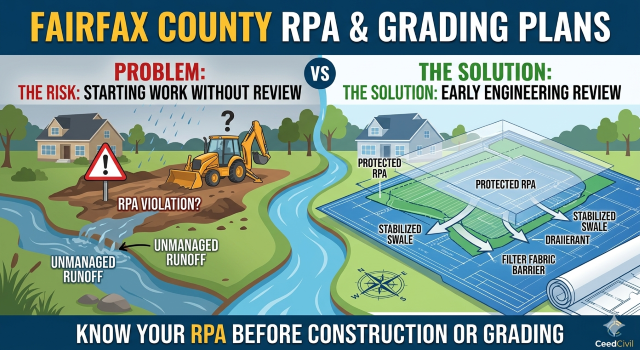
Fairfax County RPA and Grading Plans: What Property Owners Need to Know Before Starting Work
You may have checked the zoning.
You may have hired a contractor.
You may even know exactly where the new addition or structure will go.
Then someone mentions an RPA.
Now the project may need another level of review.
A Resource Protection Area can affect what can be built and how site work is planned. If your property is in or near an RPA, it is better to find that out before construction or grading begins.
What Is an RPA?
RPA stands for Resource Protection Area.
Fairfax County uses RPA requirements to protect environmentally sensitive areas associated with waterways and related resources.
For some projects, the location of an RPA can affect the type of review, plan, or approval needed.
Why Does This Matter for Grading?
A project may disturb soil outside the visible area where construction is taking place.
Excavation, grading, drainage work, access, erosion controls, and other site activities can extend beyond the footprint of the proposed building.
If an RPA affects the property, that can change the planning process.
Fairfax County states that RPA boundary delineation studies or RPA plans may be required for applicable site-related plans where an RPA is shown on the county’s adopted map.
A Small Addition Can Still Require Review
Fairfax County has a separate process for certain minor residential additions located within an RPA.
Eligibility depends on several conditions, including when the house was built, whether the addition is attached to the primary dwelling, the size of the proposed addition, and the amount of land disturbance.
Detached structures such as pools and detached garages are treated differently from attached additions.
So a homeowner shouldn’t assume that all residential projects receive the same RPA treatment.
The 2,500-Square-Foot Threshold Can Change the Process
Land disturbance is again an important factor.
Fairfax County states that when proposed land disturbance exceeds 2,500 square feet and a grading plan is required, a separate RPA process or form may apply.
This is why an accurate estimate of total land disturbance matters.
It’s not enough to measure only the new structure.
Which Projects Should Look for RPA Issues?
Before moving forward, an RPA review may be worth considering for projects involving:
- Home additions
- New homes
- Pools
- Detached garages
- Significant grading
- Drainage improvements
- Land clearing
- Other projects involving substantial land disturbance
The actual requirements depend on where the work is located and the conditions of the property.
Don’t wait for the plan to be complete If an RPA problem is discovered after the grading plan has been developed, the plan will have to be redesigned and this will cause delays.
It’s better to identify site constraints early.
A preliminary review can help determine whether the property is affected by an RPA, whether additional delineation is needed, and how that may influence the proposed construction or grading.
RPA, Drainage, and Grading Are Often Connected
Environmental restrictions and grading can’t always be treated as separate issues.
A proposed change to drainage may involve grading. Grading may require erosion controls. The location of the work may affect protected areas.
That is why site planning works best when these conditions are reviewed together instead of one at a time after construction has already started.
If you’re planning construction or grading on a Fairfax County property and are concerned about an RPA, drainage, or site-development requirements, CeedCivil can help evaluate the property and identify the civil engineering and planning issues that may need to be addressed.
RPA and site-development requirements are property-specific. Current Fairfax County requirements should be confirmed before beginning work.