
How Fairfax County Calculates Land Disturbance: The 2,500-Square-Foot Rule Explained
A homeowner may look at a 1,500-square-foot addition and assume the project involves only 1,500 square feet of land disturbance.
That isn’t necessarily how Fairfax County calculates it.
The total disturbed area can include more than the footprint of the new structure. This is one of the reasons property owners sometimes discover that a project has more site-development requirements than they expected.
Fairfax County uses specific methods to calculate land disturbance, and the 2,500-square-foot threshold is an important number to understand before starting work.
What Counts Toward Land Disturbance?
Fairfax County’s Land Development Services explains that the calculation can include several areas associated with the project.
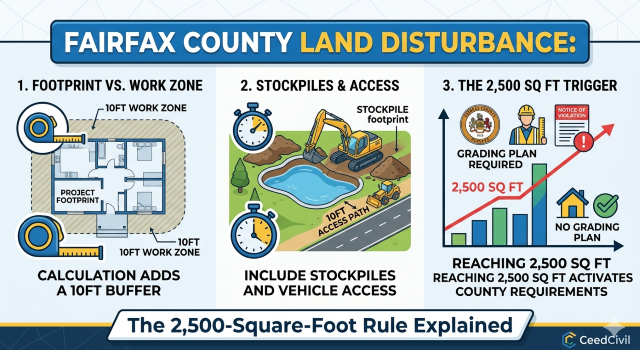
The county’s guidance says the total disturbed area includes:
- The project footprint
- A 10-foot-wide work zone around the project footprint
- A 10-foot-wide access path from the existing street or driveway to the project footprint
- A stockpile area matching the project footprint when excavation is involved, such as for a pool or basement foundation
That means the number you see on an architectural drawing may not be the same as the total land disturbance used for county review.
Why Does 2,500 Square Feet Matter?
Fairfax County states that projects equaling or exceeding 2,500 square feet of land disturbance may require a land disturbance permit and approved grading plan before work begins.
The county also warns that starting land-disturbing activity without the required approvals can result in a violation.
This is particularly important for homeowners planning additions, pools, garages, grading work, or other improvements that require excavation or changes to the property.
A Pool Is a Good Example
Imagine you’re installing a new swimming pool.
The pool itself may have a relatively small footprint.
But construction may require:
- Excavation
- A work area around the pool
- Equipment access
- Soil stockpiling
- Grading
- Drainage improvements
The disturbed area can therefore be considerably larger than the pool itself.
Fairfax County specifically includes a stockpile footprint in the disturbance calculation when excavation such as a pool or basement foundation is involved.
Why Home Additions Can Be Tricky
The same issue applies to additions.
Suppose a homeowner plans a 1,800-square-foot addition.
That doesn’t automatically mean the land disturbance is 1,800 square feet.
The work zone and access area can increase the total. If excavation is involved, additional disturbed area may also need to be considered.
This is why it is better to calculate the disturbance before construction rather than after the contractor has already cleared the site.
What Happens at 2,500 Square Feet?
Once the project reaches the applicable threshold, additional county requirements can come into play.
Fairfax County identifies approved grading plans and land disturbance permits among the approvals that may be required for projects at or above 2,500 square feet.
Depending on the project, the appropriate site-related plan could be an Infill Lot Grading Plan (INF), Conservation Plan, Rough Grading Plan (RGP), or another plan type.
The threshold doesn’t automatically tell you which plan you need.
It tells you that the project deserves a closer look.
What If You’re Already Over the Threshold?
If construction has already started and the disturbance exceeds the applicable limit without the required approval, don’t simply continue the work and hope the issue goes away.
Fairfax County states that disturbing 2,500 square feet or more without an approved plan can result in a violation.
If an NOV has already been issued, the next step should be to understand the violation and determine what corrective action is required.
Don’t Estimate Land Disturbance From the Building Footprint Alone
This is probably the biggest takeaway.
A project that looks small on a floor plan may be much larger once construction access, work zones, excavation, stockpiles, and grading are considered.
Before starting work, calculate the actual disturbance and determine what Fairfax County approvals apply.
That can save a homeowner from discovering halfway through construction that a grading plan or other site approval was required.
Planning an addition, pool, garage, grading project, or other site work in Fairfax County? CeedCivil can help evaluate the proposed disturbance and determine what civil engineering and site-plan requirements may apply.
County requirements are project-specific and can change. Confirm current requirements with Fairfax County before beginning land-disturbing work.