
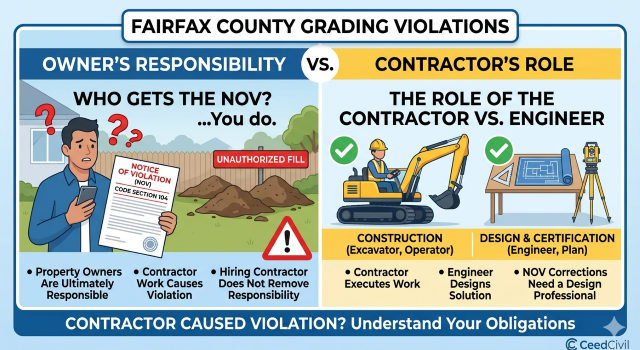
Fairfax County Grading Violation After Contractor Work: Who Is Responsible?
You hired a contractor.
The work was completed.
Then you receive a Fairfax County Notice of Violation.
Your first thought may be:
“The contractor did it. Why am I responsible?”
It’s a reasonable question.
But property owners should understand that hiring a contractor doesn’t automatically remove the owner’s responsibilities under county requirements.
If unauthorized grading, fill, or land disturbance has occurred, the situation needs to be addressed regardless of who physically performed the work.
The Property Owner May Still Be Part of the Problem
Fairfax County’s land-disturbance guidance specifically warns property owners about activities such as accepting fill dirt without an approved grading plan. The county also states that disturbing 2,500 square feet or more without an approved plan results in a violation.
So if a contractor says:
“Don’t worry. We’ll just bring in some dirt and level it.”
That isn’t necessarily enough.
The property owner should know whether the work requires county approval before it begins.
Contractors and Engineers Have Different Roles
A contractor performs construction.
A civil engineer or other qualified design professional may be responsible for preparing or certifying applicable plans.
These roles overlap during a project, but they’re not identical.
For example, an excavator can move soil.
That doesn’t mean the excavator should decide the final elevations, drainage design, stormwater requirements, or applicable county plan type.
Those decisions may require professional design.
What If the Contractor Said No Permit Was Needed?
Get the answer in writing if possible.
Then verify it.
Fairfax County has specific requirements for land-disturbing activities and site-related plans. The county says approvals may include a land disturbance permit and approved grading plan for projects equaling or exceeding 2,500 square feet of disturbance.
A contractor’s assumption doesn’t replace the county’s requirements.
What If the Work Is Already Complete?
Don’t make the situation worse by immediately changing the property again.
First, determine:
What work was performed?
How much land was disturbed?
What grades were changed?
Was fill added?
Was drainage altered?
Was there an approved plan?
Was the work performed outside the approved limits?
If an NOV has been issued, review the notice carefully. Fairfax County says the NOV identifies the observed violation, corrective action, timeframe, and investigator contact information.
The Existing Site May Need to Be Documented
When unauthorized work has already happened, the professional preparing the corrective plan needs to understand what exists today.
That may require reviewing surveys, elevations, drainage features, previous plans, photographs, permits, and the NOV.
The proposed correction then needs to be designed around the actual conditions.
What If an INF or RGP Is Required?
The correct plan depends on the situation.
Fairfax County’s INF requirements apply to certain residential construction projects involving more than 2,500 square feet of disturbance and stormwater management improvements.
RGP requirements apply to different circumstances, and Fairfax County specifically provides for NOVs and Corrective Work Orders to be included when applicable.
The existence of an NOV doesn’t automatically determine which plan is required.
The corrective work does.
Can the Contractor Fix Everything?
Possibly, the contractor may be responsible for performing the physical corrective work.
But if the correction requires engineering design or a certified plan, that is a separate part of the process.
Think of it this way:
The contractor builds the correction.
The design professional determines what the correction should be.
The county reviews the applicable submission.
All three parts need to line up.
What Should a Homeowner Do?
If a contractor’s work resulted in a grading or site violation, gather everything you have:
- The contract
- Invoices
- Emails and messages
- Photos before and after construction
- Existing surveys
- Approved plans
- Permits
- The Notice of Violation
- Information about the work performed
Then have the site evaluated before deciding what physical correction to make.
That can help separate the question of who performed the work from the more important question of what needs to be done now to bring the property into compliance.
Received a Fairfax County NOV after contractor-performed grading, fill, drainage, or site work? CeedCivil can evaluate the existing conditions and help determine what engineering and plan support may be needed.
Responsibility for a specific violation depends on the facts and applicable law. This article is general information and is not legal advice.