
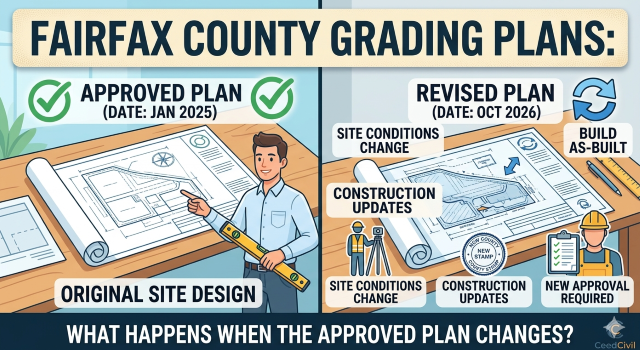
Fairfax County Grading Plan Revisions: What Happens When the Approved Plan Changes?
Construction rarely goes exactly according to the first drawing.
A driveway moves.
The homeowner changes the location of an addition.
A retaining wall becomes necessary.
Existing site conditions turn out to be different from what was expected.
Or the contractor discovers that the approved grading doesn’t work the way originally anticipated.
When the approved site conditions change, the question becomes:
Can you simply build the new version?
Not always.
An Approved Plan Is There for a Reason
A grading plan documents the site conditions and proposed work that Fairfax County reviewed.
If construction changes significantly from what was approved, the revised work may need to go through an appropriate revision process.
Fairfax County’s RGP guidance, for example, specifically provides a process for revisions to previously approved plans and requires a verifiable digital signature from the licensed design professional.
The exact process depends on the type of plan and the proposed change.
Why Changing the Grade Can Matter
A change that looks small on a drawing can have a large effect on drainage.
Suppose the approved plan directs runoff around one side of a house.
During construction, the contractor changes the finished elevation.
Now water flows toward the house instead.
The change may affect more than aesthetics.
It can alter drainage, stormwater management, erosion controls, or neighboring conditions.
What If the Homeowner Wants to Add More Fill?
This is a common situation.
The homeowner decides the backyard is too low and wants to add soil.
But Fairfax County warns that accepting fill without an approved grading plan can result in a violation. The county also says new land disturbance should not begin before an approved grading plan has been officially released when one applies.
So additional fill shouldn’t automatically be treated as a simple landscaping change.
What If the Project Is Already Under Construction?
Stop and check before making a change that could affect the approved grading.
Ask the design professional:
- Does this change affect the approved grades?
- Does it affect drainage?
- Does it change land disturbance?
- Does it change stormwater management?
- Does the county need a revised plan?
- Does the change affect an RPA or another site restriction?
It is much easier to address a design change before the work is completed.
What Happens If You Build the Change First?
You may end up with an as-built condition that doesn’t match the approved plan.
If the county identifies the difference as a violation, you may then need to document the existing conditions and determine how to correct the situation.
That’s when a simple construction change can turn into a compliance project.
2026 Updates Make Current Documents Important
Fairfax County revised its INF cover sheet in 2026, with the revised April 2026 version required for first-submission INF plans beginning June 1, 2026. RGPs associated with major plans are also subject to the revised cover-sheet requirements.
This is a good reminder that old plans and forms shouldn’t automatically be reused for a new submission.
Current county requirements matter.
What If the Change Is Related to an NOV?
Then the situation deserves even more care.
Fairfax County’s INF and RGP requirements specifically address site-related plans submitted to address Notices of Violation and Corrective Work Orders.
If an approved plan already exists and an NOV is now involved, the correction should be coordinated with the existing approvals and the county’s current requirements.
Don’t Let a Field Change Become a Compliance Problem
Construction changes happen.
The important thing is how you handle them.
Before changing grades, adding fill, moving drainage features, or expanding the disturbed area, have the change reviewed.
A quick engineering check can be much cheaper than redesigning the site after construction is complete.
Need to revise an approved Fairfax County grading plan or deal with changes made during construction? CeedCivil can help evaluate the proposed change and determine what engineering or plan revision may be required.
Plan revision requirements vary by project and plan type. Confirm the applicable process with Fairfax County and the project’s design professional.