
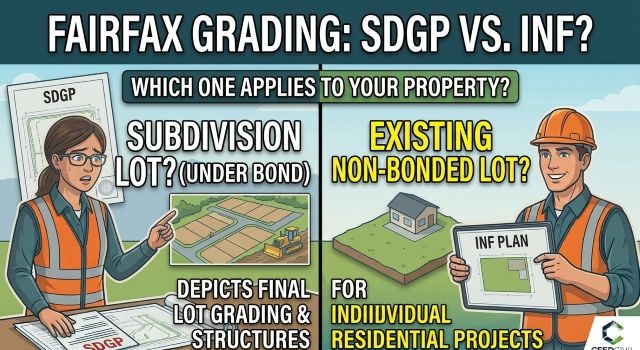
Fairfax County Subdivision Grading Plan vs. INF: Which One Applies to Your Property?
Two properties can both be residential and still require completely different grading plans.
One may need an Infill Lot Grading Plan (INF).
Another may need a Subdivision Grading Plan (SDGP).
The difference often comes down to how the property was created and what approval is associated with it.
What Is an INF?
Fairfax County describes an INF as a plan required for certain non-bonded single-family residential construction involving more than 2,500 square feet of land disturbance and stormwater management improvements.
It is commonly associated with individual residential projects such as new homes or substantial improvements.
What Is a Subdivision Grading Plan?
A Subdivision Grading Plan is different.
Fairfax County states that an SDGP is required for each individual lot that is part of a new residential subdivision with an active, approved subdivision plan under bond.
That distinction is important.
Why Does the Subdivision Matter?
When a subdivision is created and remains under an active approved subdivision plan, the individual lots can be subject to subdivision-specific grading requirements.
The grading plan addresses the individual lot and proposed improvements.
Fairfax County says an SDGP depicts final lot grading and proposed improvements, including the size, location, and configuration of structures.
What If You Bought a New Construction Lot?
Ask the builder or developer about the subdivision plan.
Don’t automatically assume you need an INF simply because you’re building a single-family home.
If the lot is part of a new subdivision with an active approved subdivision plan under bond, an SDGP may be the applicable plan type.
What If the Property Is an Older Existing Lot?
An existing non-bonded residential property may fall into a different category.
Depending on the proposed project, an INF, Conservation Plan, RGP, or another site-related plan may apply.
The property history matters.
What Does the SDGP Show?
The plan addresses final lot grading and proposed improvements.
That can include the location and configuration of structures and other site features.
The goal is to establish how the individual lot is intended to function within the approved subdivision.
Does an SDGP Need a Licensed Professional?
Yes.
Fairfax County states that homeowners or authorized agents can submit subdivision grading plans, but the plan itself must be certified by a qualified professional licensed in Virginia.
The same general principle applies to INF plans.
What If the Builder’s Plan Doesn’t Match the House You Want?
This can happen.
Maybe you want to move the house.
Maybe you want a larger driveway.
Maybe you want to add a retaining wall.
Maybe you’re changing the lot grading.
Don’t assume that the builder’s original grading plan automatically covers the new design.
The proposed changes should be evaluated against the approved subdivision plan and applicable county requirements.
What If the Lot Has Drainage Problems?
New construction doesn’t eliminate drainage concerns.
The proposed house and site improvements need to work with the approved subdivision grading and drainage design.
If the site conditions are different from the plan, that difference should be addressed before construction moves too far.
What If There Is an Existing Violation?
Tell your engineer.
An NOV can affect the applicable plan process and corrective work.
Don’t treat a violation as unrelated paperwork.
It may change what needs to be shown or corrected.
Why the Plan Type Matters
Using the wrong plan type can waste time.
You may prepare a detailed drawing only to discover that the property needs a different submission.
The easiest time to determine the correct plan is before design begins.
What Should You Provide?
If you’re unsure which grading plan applies, provide:
The property address.
Your purchase or subdivision documents.
Any builder plans.
Existing surveys.
Approved subdivision plans if available.
Architectural plans.
County correspondence.
Any NOVs or corrective documents.
Your engineer can then evaluate the property history and proposed work.
Building or modifying a home in a Fairfax County subdivision and unsure whether you need an SDGP, INF, or another grading plan? CeedCivil can review the property and project scope and help identify the applicable civil engineering requirements.
Plan requirements depend on the property’s approval history and proposed work. Confirm current Fairfax County requirements before submitting.