
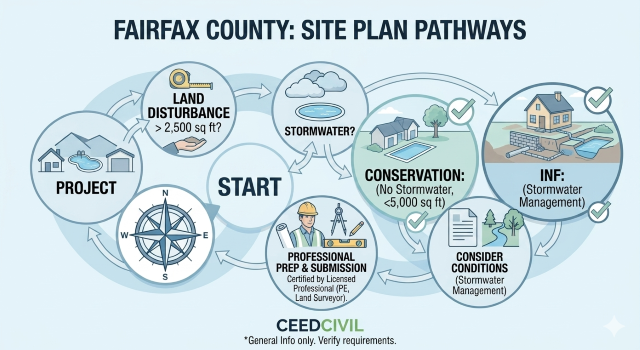
which one do you need?
Planning a pool, detached garage, home addition, or another residential improvement in Fairfax County?
You may hear two terms during the planning process: Conservation Plan and Infill Lot Grading Plan (INF).
They’re not interchangeable.
Choosing the right type of site-related plan starts with understanding what you’re proposing and how much land will be disturbed.
what is a conservation plan?
Fairfax County describes a Conservation Plan as a site grading plan used for certain residential additions and accessory structures, such as swimming pools and detached garages.
It can apply when land disturbance is between 2,500 and 5,000 square feet and stormwater improvements are not required.
That last part matters.
The square footage alone doesn’t determine whether a Conservation Plan is appropriate.
what is an inf?
An Infill Lot Grading Plan is used for certain non-bonded single-family residential construction projects.
Fairfax County states that an INF is required when more than 2,500 square feet of land will be disturbed and stormwater management improvements are included.
So while both plan types can involve residential properties and grading, their requirements are different.
why difference matters?
Imagine a homeowner wants to build a detached garage.
The project may disturb a certain amount of land, but the appropriate plan depends on the complete project conditions, including stormwater requirements.
Now consider a different property where a new single-family residence is being constructed and stormwater management improvements are part of the project.
That may point toward an INF rather than a Conservation Plan.
The lesson is simple: don’t choose the plan based only on the name of your project.
Fairfax County Has Several Site-Related Plan Types
Fairfax County’s Site Plans Permit Library identifies several types of site-related plans, including:
- Infill Lot Grading Plan
- Conservation Plan
- Rough Grading Plan
- Subdivision Grading Plan
- Site Plan
- Subdivision Plan
- Public Improvement Plan
Each serves a different purpose.
That’s why a property owner should look at the complete scope of work before deciding which plan to pursue.
what about stormwater?
Stormwater is often one of the details that changes the answer.
Fairfax County specifically notes that most plans are subject to stormwater management requirements under the Erosion and Stormwater Management Ordinance. The county also states that when the criteria for a Conservation Plan cannot be met, an INF may be the more appropriate option.
This is one reason it’s risky to rely on a general rule such as:
“My project is under 5,000 square feet, so I need a Conservation Plan.”
That’s not enough information.
what if there is already a violation?
Existing site problems can change the situation again.
Fairfax County’s current Conservation Plan requirements identify Notices of Violation and Corrective Work Orders as applicable documents that may need to accompany a submission. The county’s INF requirements contain similar provisions.
If you’re trying to correct an existing grading or site issue, the first step should be understanding exactly what the county requires rather than selecting a plan based on a generic description.
what about an rgp?
An RGP is another separate option.
Fairfax County generally requires an RGP when land disturbance exceeds 2,500 square feet and clearing and grading aren’t depicted on another applicable plan.
Again, the correct plan depends on the project.
This is why an experienced civil engineering review can be useful before you spend money on construction or submit documents that may need to be revised.
Start With the Property, Not the Form
The best way to approach Fairfax County site development is to start with the actual property and proposed work.
What are you building?
How much land will be disturbed?
Will grading change drainage?
Are stormwater improvements required?
Are there existing approvals?
Is there an NOV or Corrective Work Order?
Are there environmental or RPA considerations?
Those questions help determine what type of plan may be required.
Planning an addition, pool, garage, new home, grading project, or site correction in Fairfax County? CeedCivil can help evaluate your project and identify the appropriate civil engineering and site-plan requirements.
This article provides general information and is not a substitute for project-specific professional advice or confirmation from Fairfax County.
what if the rgp is related to a notice of violation?
This is another situation where the details matter.
Fairfax County’s RGP requirements specifically address Notices of Violation and Corrective Work Orders when applicable. The county also references Technical Bulletin 23-04 for RGPs submitted to address NOVs.
If your property has received an NOV involving grading or land disturbance, don’t assume an RGP is automatically the answer.
The existing violation, site conditions, proposed corrective work, and applicable county requirements all need to be considered.
Before You Start Moving Dirt
If a project involves substantial grading or clearing, it’s worth determining the required plan before equipment arrives on the property.
Starting work first and trying to document it later can create a much harder situation, particularly if the actual site conditions differ from what was originally proposed.
A civil engineering professional can help evaluate the property, identify the appropriate site-related plan, and prepare the documentation needed for the applicable review process.
If you’re planning grading, demolition, site work, or correcting a Fairfax County site violation, CeedCivil can help you determine whether an RGP or another site-related plan is appropriate.
Requirements can vary based on the project and property. Confirm current Fairfax County requirements before beginning land-disturbing activities.