
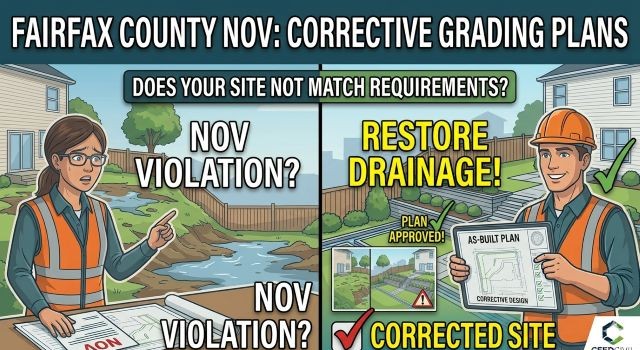
Fairfax County Corrective Grading Plan: What Happens When Your Existing Site Doesn’t Match the Requirements?
Sometimes the problem isn’t what you’re planning to build.
The problem is what is already there.
Maybe a previous owner added fill.
Maybe a contractor graded the backyard without the required approval.
Maybe a retaining wall was installed in a different location.
Maybe drainage was changed years ago.
Now Fairfax County wants the property corrected.
This is where a corrective grading plan or other site-related engineering documentation may become necessary.
Start With the Existing Condition
The first step isn’t designing the fix.
It’s documenting the problem.
What is actually on the property today?
Where are the current elevations?
Where does water flow?
Where was soil added?
What structures exist?
What work was performed?
If an engineer designs the correction without understanding the existing site, the plan may not solve the actual problem.
Find Out Why the Site Is Noncompliant
There can be several reasons.
For example:
Unauthorized grading.
Unapproved fill.
Drainage changes.
Construction that differs from approved plans.
Land disturbance without required approval.
Failure to follow an approved grading design.
An existing Notice of Violation can help identify what Fairfax County believes needs to be corrected.
Give the Engineer the Complete NOV
If you’ve received an NOV, provide the entire document.
Don’t send only the page that mentions grading.
The county may have included specific corrective requirements, deadlines, or references to applicable regulations.
Those details can affect the engineering work.
Fairfax County’s Conservation Plan requirements specifically call for applicable NOVs and Corrective Work Orders to be included with submissions when relevant.
Does Every Violation Need a New Grading Plan?
No.
The appropriate response depends on the violation.
Some situations may require physical correction.
Others may require documentation.
Some may require a site-related plan.
Fairfax County has different plan types for different circumstances.
For example, an RGP is used when applicable land disturbance exceeds 2,500 square feet and the clearing and grading isn’t shown on another applicable plan.
What If the Property Was Graded Years Ago?
That doesn’t necessarily make the issue disappear.
Older site conditions can still affect current construction.
If you’re now planning an addition, pool, or another project, the existing grading needs to be considered.
An old unauthorized grade can become relevant to a new application.
What If You Don’t Know Who Did the Work?
That is common with older properties.
You may have purchased the property after the grading occurred.
You may not have the original contractor’s information.
You may not even know how much soil was added.
Start with what you do know.
A survey, photographs, county records, previous plans, and current site measurements can help reconstruct the situation.
What About Drainage?
Drainage is often the key issue in corrective grading.
Suppose a previous owner raised the backyard.
The grade now pushes water toward a neighboring property.
Simply removing a portion of the fill may not restore the site to a workable condition.
The correction needs to establish appropriate grades and drainage.
Could an INF Be Used for Corrective Work?
It can be relevant in certain situations.
Fairfax County’s INF guidance specifically includes requirements for plans submitted to address Notices of Violation.
But that doesn’t mean every NOV requires an INF.
The appropriate plan type depends on the property and corrective work.
What About an RGP?
An RGP can be appropriate when the project’s proposed land disturbance and grading fall within the county’s RGP criteria.
Fairfax County describes RGPs as plans for situations where land disturbance exceeds 2,500 square feet and the proposed clearing and grading isn’t depicted on another applicable plan.
Again, the actual project determines the plan type.
Don’t Correct the Site by Guessing
If you’ve received a violation, avoid the temptation to make several changes at once.
Adding fill.
Removing fill.
Digging a swale.
Moving a retaining wall.
Installing a pipe.
Each change can affect the next one.
Develop the correction first.
Then perform the work according to the approved approach.
What Should a Corrective Plan Accomplish?
The plan should provide a clear picture of:
The existing condition.
The problem being corrected.
The proposed grades.
The drainage solution.
Applicable erosion and stormwater measures.
The relationship to structures and property boundaries.
Any applicable county requirements.
The exact contents depend on the project.
A Violation Can Become More Expensive When Ignored
The longer an unresolved site problem sits, the more likely it is that additional construction will make the situation complicated.
A new addition can cover an area that needs to be corrected.
New landscaping can hide the existing grade.
Additional fill can change drainage again.
If you know there is an unresolved grading issue, deal with it before adding more work to the property.
Have a Fairfax County NOV or an existing grading problem that needs to be corrected? CeedCivil can evaluate the existing site conditions and help determine the appropriate grading, drainage, and civil engineering documentation for the corrective process.
This article is general information and not legal advice. Follow the requirements in your Notice of Violation and confirm current county requirements.