
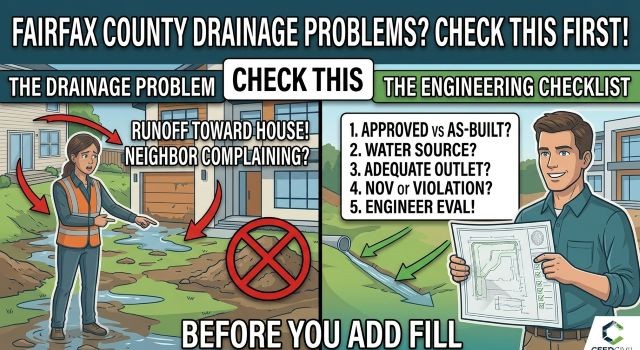
Fairfax County Drainage Problems After Grading: What Should You Check First?
The grading work is finished, but now there is a new problem.
Water is collecting in the backyard.
Or it is running toward the house.
Maybe your neighbor says runoff is now entering their property.
This can happen when grading changes the way water moves across a site.
If you’re dealing with a drainage problem after grading in Fairfax County, don’t immediately start moving more dirt. First, figure out what changed.
Start With the Existing and Proposed Grades
The first question is simple:
What was the property supposed to look like, and what does it look like now?
A grading plan shows elevations and drainage patterns. If the constructed grades don’t match the approved design, that difference can help explain the problem.
This is particularly important when the property has already gone through a Fairfax County grading or site-plan process.
Look at Where the Water Is Coming From
Standing water doesn’t always mean that the low spot itself is the problem.
Water may be coming from:
- A roof downspout
- An uphill portion of the property
- A driveway
- A neighboring property
- A swale
- A drainage pipe
- A changed grading pattern
Before fixing the low point, determine what is feeding it.
Look at Where the Water Is Going
The other half of the question is the outlet.
Where does the runoff go after it reaches the low area?
If the answer is “nowhere,” you may have a drainage problem.
If the answer is “my neighbor’s property,” you may have a bigger problem.
A grading correction should consider the complete drainage path rather than simply moving water from one location to another.
Did the Grading Change an Existing Drainage Pattern?
Fairfax County’s site-related plan guidance identifies situations where construction blocks or alters existing drainage patterns as a consideration when determining the appropriate type of site-related plan.
That’s an important point for homeowners.
Changing an elevation isn’t always just cosmetic.
It can change the way water crosses the property.
What If the Problem Started After Construction?
Document it.
Take photographs during and after rainfall when it is safe to do so.
Keep photographs from before construction if you have them.
Find the approved grading plan.
Keep contractor records.
If the county has inspected the property or issued correspondence, save those documents as well.
Having a record of what changed can make the engineering evaluation much easier.
What If the Contractor Says the Drainage Is Fine?
Ask the contractor to explain where the water is supposed to go.
If there is an approved grading plan, compare the finished work with that plan.
If the site doesn’t match the approved grades, the issue may need to be reviewed before more work is performed.
Could a New Grading Plan Be Needed?
That depends on the circumstances.
Fairfax County uses different site-related plans depending on the project.
An RGP is required when proposed land disturbance exceeds 2,500 square feet and the clearing and grading isn’t depicted on another applicable plan.
An INF is used for certain non-bonded single-family residential construction projects involving more than 2,500 square feet of disturbance and stormwater management improvements.
The correct plan depends on the actual project.
What If Fairfax County Has Already Issued an NOV?
Then don’t treat the drainage issue as a separate landscaping problem.
Provide the engineer with the complete Notice of Violation.
Fairfax County’s Conservation Plan requirements, for example, specifically call for applicable Notices of Violation and Corrective Work Orders to be included when relevant.
The corrective design needs to address the condition identified by the county.
Don’t Add More Fill Just Yet
Adding more soil may appear to solve a low spot.
But it also changes the elevation again.
That can change the drainage again.
If you’re already dealing with a drainage complaint or NOV, unplanned grading can make the situation harder to resolve.
Get the Site Evaluated
A civil engineer can evaluate the existing grades, proposed grades, drainage patterns, and applicable county requirements.
The goal is to understand the problem before deciding on the correction.
Dealing with drainage problems after grading in Fairfax County? CeedCivil can evaluate grading and drainage conditions and help determine whether a corrective grading plan or other civil engineering documentation is needed.
This article is general information. Project-specific requirements should be confirmed with Fairfax County.