
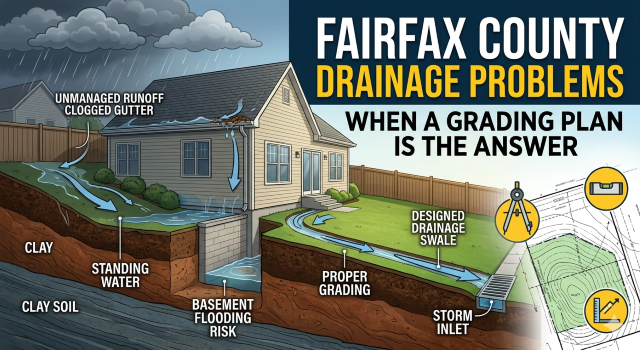
Fairfax County Drainage Problems: When a Grading Plan May Be the Answer
Water problems have a way of exposing issues that weren’t obvious before.
A backyard floods after a heavy storm. Water collects near the foundation. Runoff starts crossing into a neighbor’s property. A drainage swale that once worked no longer seems to do anything.
The first instinct is often to call a landscaper and start moving dirt.
That may help. Or it may make the problem worse.
When drainage issues involve significant grading or land disturbance, a properly designed grading plan may be part of the solution.
Why Grading and Drainage Are Connected
Water follows the ground.
Change the elevation, and you can change where the water goes.
Even a relatively small change to one part of a property can affect drainage elsewhere. Raising a backyard may redirect runoff toward a house. Filling a low area may push water toward a neighboring lot. A new driveway can prevent water from following its previous path.
That is why drainage problems should be evaluated as site problems, not simply landscaping problems.
Fairfax County notes that unmanaged stormwater runoff contributes to localized flooding and erosion, particularly in urbanized watersheds and established neighborhoods.
A Drainage Problem Doesn’t Always Mean You Need an INF
There is no single plan for every drainage issue.
Depending on the property and proposed work, the appropriate solution may involve an INF, Conservation Plan, Rough Grading Plan, or another type of site-related approval.
Fairfax County distinguishes between these plans based on factors such as the type of project, the amount of land disturbed, and whether stormwater improvements are required.
The first step is understanding the existing condition.
Start With the Source of the Water
Before designing a solution, ask:
Where is the water coming from?
Is the runoff coming from your roof? A neighboring property? An uphill area? A public drainage system? Is the problem happening only during major storms, or does water remain on the property for days?
Those details matter.
A drainage swale might help one property but be completely ineffective on another. A French drain may address a localized problem but not solve runoff entering the property from a larger drainage area.
The solution has to match the cause.
What Happens When You Change Existing Drainage?
Changing drainage without understanding the full site can create another issue.
For example, a homeowner may decide to raise one area to stop water from collecting there. The standing water disappears.
Success?
Not necessarily.
The runoff may now flow faster toward another area of the property or cross onto an adjacent lot.
Fairfax County’s stormwater requirements for applicable INF projects include water quantity considerations and downstream outfall analysis because runoff impacts can extend beyond the immediate area being improved.
Drainage Work Can Trigger Other Requirements
A drainage problem may lead to work involving:
- Regrading
- Swales
- Stormwater facilities
- Pipes
- Inlets
- Retaining structures
- Fill or soil removal
- Erosion and sediment controls
Once the work becomes significant, land-disturbance requirements may apply.
Fairfax County states that land-disturbing activity of 2,500 square feet or more is subject to its erosion and stormwater management requirements.
What If the Drainage Problem Caused a Violation?
If grading or drainage work was performed without the required approvals, the situation may involve a Notice of Violation.
At that point, simply changing the site again without a plan can make things more complicated.
Fairfax County’s site-related plan requirements specifically provide for NOVs and Corrective Work Orders to be included when applicable to plan submissions.
The existing conditions, the violation, and the proposed correction should all be evaluated together.
A Proper Plan Looks at the Whole Property
The goal isn’t just to get water away from one spot.
A good grading and drainage solution considers where the water starts, how it moves across the property, and where it ultimately goes.
That may involve reviewing:
- Existing topography
- Proposed grades
- Roof runoff
- Impervious surfaces
- Existing drainage systems
- Neighboring conditions
- Downstream drainage
- Stormwater requirements
The right answer depends on the property.
If you’re dealing with flooding, standing water, drainage changes, or a Fairfax County grading violation, CeedCivil can help evaluate the site and determine whether a grading or drainage plan may be needed.
This article provides general information. Site-specific drainage and engineering requirements should be evaluated based on the actual property.