
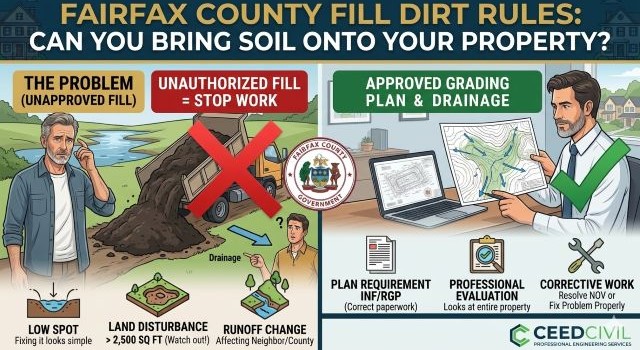
Fairfax County Fill Dirt Rules: Can You Bring Soil Onto Your Property?
You’ve got a low spot in the backyard.
After heavy rain, it holds water.
Your contractor suggests bringing in several loads of dirt to raise the area.
It sounds like a simple solution.
But before the trucks arrive, there is an important Fairfax County question to answer:
Do you need an approved grading plan before accepting fill?
In many cases, the answer can be more complicated than homeowners expect.
Adding Fill Changes the Property
Fill isn’t just dirt.
Once soil is placed on a property, the elevation changes.
That can affect how stormwater moves across the site.
If you raise one portion of the yard, water that previously collected there may move somewhere else.
It could flow toward the house.
It could move toward a neighboring property.
It could affect an existing drainage feature.
That is why Fairfax County treats unauthorized fill as a serious site-development issue.
Fairfax County Specifically Warns About Fill
Fairfax County’s land-disturbance guidance warns property owners about accepting fill dirt without an approved grading plan.
The county also states that disturbing 2,500 square feet or more without an approved plan can result in a violation.
So if a contractor says, “It’s just fill,” that isn’t enough to determine whether approval is required.
Why Homeowners Get Into Trouble
The problem often starts with a reasonable goal.
The backyard is too low.
There is standing water.
The homeowner wants a flatter lawn.
The contractor recommends adding soil.
Several truckloads arrive.
The grade changes.
Then a neighbor complains about runoff or the county notices the unauthorized grading.
Now the homeowner is dealing with an NOV instead of simply fixing a drainage problem.
How Much Fill Can You Add?
There isn’t one simple answer that applies to every property.
The amount, location, purpose, resulting grading, drainage, land disturbance, and applicable county requirements all matter.
Adding a small amount of soil for routine landscaping is not automatically the same as performing significant grading.
But property owners should not assume that a project is exempt simply because it involves dirt rather than construction.
What If You Are Trying to Fix Drainage?
This is where professional evaluation can make a big difference.
Suppose water collects at the back of your yard.
Adding two feet of soil might eliminate the low spot.
But where does that water go now?
If the new grade sends runoff toward your neighbor, you haven’t really solved the problem.
You’ve moved it.
A grading and drainage evaluation looks at the property as a whole.
What If You’ve Already Added the Fill?
Don’t immediately bring in another truckload to “fix” it.
First determine what the existing elevations are and what the county is requiring.
If an NOV has been issued, review the violation carefully.
The appropriate correction may require a grading plan or other engineering documentation.
Fairfax County’s plan requirements specifically address Notices of Violation and corrective work when applicable.
Can You Simply Remove the Dirt?
Maybe.
But don’t assume that’s automatically the correct solution.
The original property grade may not be the appropriate final grade.
The fill may have changed drainage.
There may be other site improvements that need to be considered.
The goal is to create a compliant site condition, not simply undo one visible action.
Fill and Drainage Are Closely Connected
A few truckloads of soil can change the flow of water.
That’s why significant fill should be considered from an engineering perspective.
A grading plan can establish proposed elevations and show how the site should drain.
It also provides documentation that can be reviewed as part of the county approval process when required.
Before You Accept Fill
If you’re considering bringing soil onto a Fairfax County property, ask:
How much soil is being added?
Where will it be placed?
What will the new elevations be?
Will drainage change?
How much land will be disturbed?
Is a grading plan required?
Are there existing site restrictions?
Could the work affect a neighboring property?
Answer those questions first.
Need to add fill, correct an existing grade, or resolve an NOV involving unauthorized fill in Fairfax County? CeedCivil can evaluate the site and help determine what grading and civil engineering work may be required.
County requirements depend on the property and proposed work. Confirm current requirements before accepting significant fill or beginning grading.