
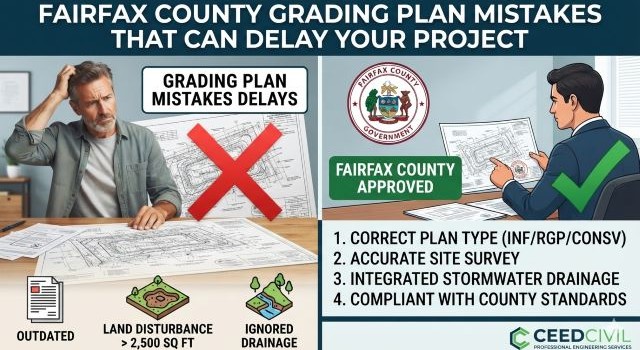
Fairfax County Grading Plan Mistakes That Can Delay Your Project
A grading plan can look simple when you’re viewing it as a homeowner.
There are lines, elevations, drainage features, notes, and a lot of technical information.
But those details have to work together.
A missing elevation or incorrect site condition can lead to questions during county review. A mismatch between the proposed grading and drainage design can require revisions.
And if you’re working against a construction schedule, every correction can matter.
Here are some of the common issues worth watching for when preparing a Fairfax County grading plan.
- Using the Wrong Plan Type
The first mistake can happen before the drawing is even started.
An INF, Conservation Plan, and RGP are not interchangeable.
The applicable plan will vary depending on the project, area of disturbance, stormwater requirements, existing conditions and other factors.
Starting with the wrong plan type can mean redesigning the submission later.
- The Price of Land Disruption
This is one of the easiest mistakes for homeowners to make.
They look at the size of the proposed addition or structure and use that number as the total disturbance.
But Fairfax County’s calculation can include construction-related work areas, access, and stockpile areas associated with excavation.
That can push a project closer to or beyond the 2,500-square-foot threshold.
- Neglecting Existing Drainage
A grading plan isn’t just about making the site level.
Water needs somewhere to go.
Existing swales, drainage paths, pipes, inlets and outfalls may all be important.
If the proposed grading doesn’t work with existing drainage, changes may be necessary during review.
- Designing Around an Old Survey Without Checking Current Conditions
A survey is useful.
But the property may have changed since it was prepared.
A homeowner may have added a patio.
A contractor may have installed a retaining wall.
Fill may have been placed.
A driveway may have changed.
If the current site does not match the information used for the plan, the proposed design may be based on wrong conditions.
- Forgetting About an Existing NOV
If the property has an existing Notice of Violation, don’t leave it out of the conversation.
Fairfax County’s current INF and RGP requirements address NOVs and Corrective Work Orders when applicable.
If the plan is being submitted to correct a violation, that information needs to be considered from the beginning.
- Treating Grading and Stormwater as Separate Problems
They aren’t always separate.
Change an elevation and you change the way water moves.
Add impervious surface and runoff can change.
Build a retaining wall and the drainage pattern may be affected.
A grading plan should therefore be considered together with the applicable stormwater requirements.
- Using Outdated Fairfax County Forms
This is easy to overlook.
County requirements and forms can change.
Fairfax County revised certain site-development cover sheets in 2026, including updates affecting INF submissions.
If you’re reusing a plan package from an older project, don’t assume the forms are still current.
Always check the latest county requirements before submission.
- Assuming County Review Is Just a Paperwork Check
It isn’t.
The county reviews whether the submitted plan meets applicable requirements.
Comments may require changes to the drawings, calculations, notes, supporting documents, or other portions of the submission.
That’s a normal part of the review process.
The goal is to respond to those comments accurately rather than simply making cosmetic changes.
- Starting Construction Before the Plan Is Approved
This can create a much bigger problem.
If the project requires an approved grading plan, starting work first can result in an NOV.
Fairfax County specifically warns property owners about land disturbance without the required approval.
Waiting for the required approval is much safer than trying to fix an unauthorized site condition afterward.
- Not Looking at the Entire Property
A grading problem doesn’t stop at the property line.
Drainage can move toward neighboring lots.
Runoff can reach streets.
An elevation change can affect an existing drainage path.
That’s why the proposed work should be considered in relation to the surrounding site.
A Better Way to Approach Your Grading Plan
Before submitting, make sure you know:
What plan type applies?
How much land will actually be disturbed?
What are the existing grades?
What are the proposed grades?
Where will stormwater go?
Are there environmental or RPA considerations?
Is there an existing NOV?
Are the current county forms and requirements being used?
Those questions can catch problems before they become review comments.
Need a Fairfax County INF, RGP, Conservation Plan, or corrective grading plan? CeedCivil can help review your project requirements and prepare the civil engineering documentation needed for the applicable county process.
Requirements vary by property and project. Confirm current Fairfax County requirements before submitting or beginning construction.