
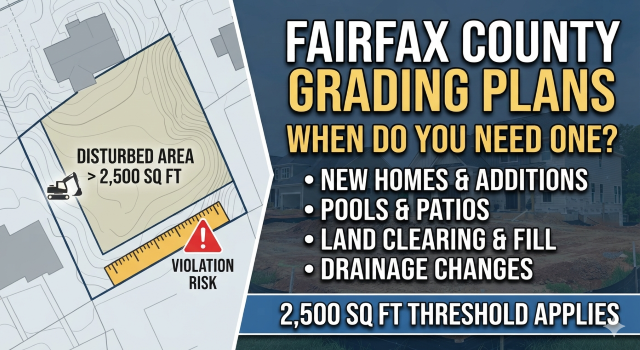
Fairfax County Grading Plans: When Do You Need One?
One of the most common questions property owners ask before starting work is:
“Do I actually need a grading plan?”
Sometimes the answer is straightforward. Other times, it depends on how much land will be disturbed, what is being built, whether the work changes drainage, and what type of property you have.
In Fairfax County, grading and land disturbance are not just construction details. Moving soil, changing elevations, clearing land, or adding fill can trigger county requirements.
The 2,500-square-foot land disturbance threshold is particularly important. Fairfax County states that disturbing 2,500 square feet or more without an approved plan can result in a violation.
What Counts as Land Disturbance?
Land disturbance can involve more than excavation for a new house.
It may include:
- Clearing land
- Removing soil
- Adding fill
- Changing the grade of the property
- Excavation
- Construction that affects the ground surface
The size and purpose of the disturbance matter.
For example, a small project that stays below the applicable threshold may be handled differently from a project involving several thousand square feet of grading.
But square footage isn’t the only thing that matters.
A Grading Plan May Be Needed When Work Changes the Site
Fairfax County has several different site-related plan types.
An Infill Lot Grading Plan (INF) is generally used for certain non-bonded single-family residential construction projects that disturb more than 2,500 square feet and include stormwater management improvements.
A Conservation Plan may apply to certain residential additions and accessory structures when land disturbance is between 2,500 and 5,000 square feet and stormwater improvements are not required.
A Rough Grading Plan (RGP) may be required when land disturbance exceeds 2,500 square feet and the proposed clearing and grading are not shown on another applicable plan.
So there isn’t one universal “Fairfax County grading plan.”
The right plan depends on the project.
Building an Addition? Don’t Assume You Don’t Need Site Work Approval
A homeowner may think:
“I’m not building a new house. It’s only an addition.”
But an addition can still involve excavation, grading, drainage changes, retaining walls, new impervious surfaces, or other site work.
Fairfax County specifically directs applicants for residential additions and alterations to determine whether their project requires an associated grading plan.
The same issue can arise with pools, detached garages, large patios, and other improvements.
Why the 2,500-Square-Foot Number Matters
Fairfax County’s erosion and stormwater requirements use 2,500 square feet as an important threshold for land-disturbing activity.
The county states that land-disturbing activities equal to or greater than 2,500 square feet must provide applicable erosion and sediment control, water quantity control, and water quality control under its current ordinance requirements.
That means a project can become more complicated once the total disturbance reaches that level.
And remember, the disturbed area may be larger than the actual footprint of the new structure.
A 1,500-square-foot addition doesn’t necessarily mean only 1,500 square feet of land will be disturbed. Construction access, excavation, grading, drainage work, and surrounding improvements can all affect the total area.
What Happens If You Start Without the Required Plan?
Starting first and sorting out the paperwork later can lead to a much more expensive problem.
Fairfax County warns that disturbing 2,500 square feet or more without an approved plan can result in a violation. The county also warns property owners about adding fill without an approved grading plan.
If work has already started, you may need to address existing conditions, prepare a plan, and explain the corrective work required.
That is very different from planning the project correctly from the beginning.
What About Drainage?
This is where many homeowners get surprised.
A project might look simple from a construction perspective, but changing the ground can change how water leaves the property.
New roofs, driveways, patios, grading, and other improvements can increase or redirect runoff.
Fairfax County specifically notes that unmanaged stormwater runoff can contribute to localized flooding and erosion, particularly in established neighborhoods. The county requires applicable INF projects to address water quality and water quantity impacts under its current stormwater requirements.
The Best Time to Ask Is Before Work Starts
If you’re planning a new home, addition, pool, detached garage, major landscaping project, or significant grading work, it’s better to determine the applicable plan requirements before equipment arrives.
A civil engineering review can help answer questions such as:
- How much land will actually be disturbed?
- Will the work change existing drainage?
- Are stormwater improvements required?
- Is an INF, Conservation Plan, RGP, or another plan appropriate?
- Are there RPA, floodplain, or other site restrictions?
Getting those answers early can prevent a project from turning into a Notice of Violation later.
Planning grading or construction work in Fairfax County? CeedCivil can help evaluate your project and determine what civil engineering and site-plan support may be needed.
Every property is different. County requirements should be confirmed based on the actual project and current Fairfax County regulations