
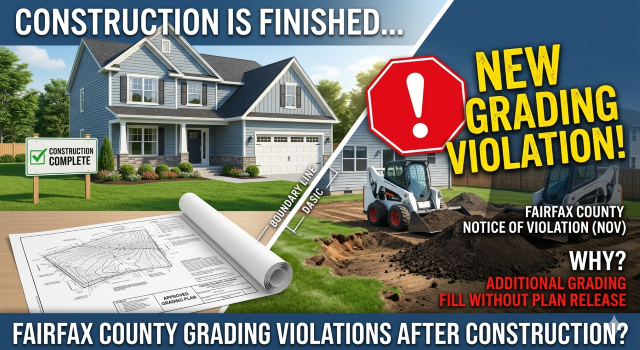
I Already Finished My Construction Project. Why Can I Still Get a Fairfax County Grading Violation?
A homeowner finishes construction.
The addition is complete. The contractor has left. The building permit has been approved.
Then the homeowner decides to make one more change outside.
Maybe level part of the backyard.
Add a few loads of fill.
Remove some soil.
Extend a patio.
It sounds like a separate project.
Sometimes it isn’t.
Fairfax County specifically warns property owners that a recently approved grading plan may still need to be officially released before new land disturbance begins. The county states that receiving a Residential Use Permit or occupancy approval does not itself mean the grading plan has been released.
Finished Construction Doesn’t Always Mean Finished Site Obligations
A building and a grading plan are not the same thing.
You may have completed construction of the house or addition while the associated site-related plan remains active.
That distinction matters.
Fairfax County advises property owners who recently improved their property under an approved grading plan to contact the county before performing new work, regardless of size, if the associated escrow deposit has not yet been refunded and the plan has not been officially released.
Why Would New Work Create a Problem?
Because the approved plan reflects specific site conditions.
The plan may show proposed grades, drainage features, stormwater facilities, erosion and sediment controls, and other improvements.
If the site is changed after approval but before the plan is officially released, the new work may not match what was approved.
For example:
A homeowner receives final approval for a new house.
A few weeks later, they bring in fill to level part of the backyard.
The house is complete, but the site conditions may now be different from the approved grading plan.
That can create a problem.
“It Was Only a Small Change”
Small construction work doesn’t always mean small site impact.
Adding soil in one area can change drainage. Extending a driveway can increase impervious surface. A new retaining wall may involve excavation and grading.
Fairfax County’s current requirements are based on the actual work and site conditions, not simply whether the homeowner considers the change minor.
Land-disturbing activity at or above the county’s applicable 2,500-square-foot threshold can trigger erosion and stormwater management requirements.
What If the Original Plan Is No Longer Accurate?
That is a situation worth addressing before doing more work.
The answer may involve a revision, additional approval, or a separate site-related plan, depending on the changes.
Fairfax County maintains different submission processes for revisions to approved site-related plans, including Rough Grading Plans.
The right approach depends on what was originally approved and what has changed.
Could You Receive a Notice of Violation?
Yes, unauthorized land disturbance can result in a violation.
Fairfax County states that disturbing 2,500 square feet or more without an approved plan will result in a violation. The county also specifically warns about accepting fill without an approved grading plan.
If you have already received an NOV, the next step should be to understand exactly what the county is asking you to correct.
Don’t assume that doing additional grading will automatically solve the problem.
Before You Change the Site Again
If your property recently had an approved grading plan, ask a few questions first:
Has the plan been officially released?
What work was originally approved?
Will the proposed work change grading or drainage?
Could the new work affect stormwater or erosion controls?
Does the proposed work require an amendment or another type of plan?
These questions are easier to answer before the work begins.
If you’ve completed construction but are planning additional grading, fill, drainage work, or other site changes in Fairfax County, CeedCivil can help review the situation and determine what engineering support may be appropriate.
County requirements depend on the approved plan, current site conditions, and proposed work.