
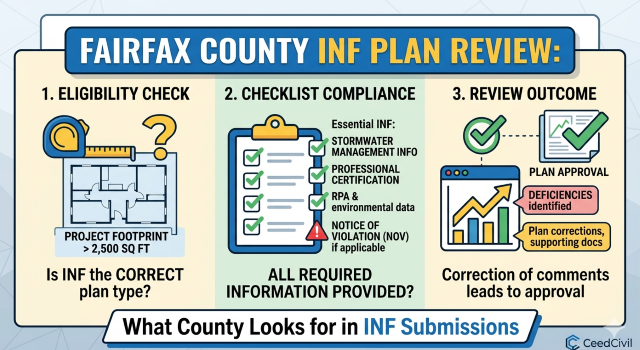
What Does Fairfax County Look for in an INF Plan Review?
Submitting an Infill Lot Grading Plan to Fairfax County does not guaranty its approval.
County reviews the submittal for completeness and for compliance with applicable requirements. If something is missing or doesn’t satisfy the requirements, the applicant may receive comments and need to submit corrections.
Understanding what the county is looking for can help property owners and design professionals prepare a better submission.
First: Is an INF the Correct Plan?
Fairfax County says an INF is required for certain single-family residential construction projects disturbing more than 2,500 square feet that include stormwater management improvements.
If disturbance does not exceed 5,000 square feet and stormwater improvements aren’t proposed, a Conservation Plan may be appropriate instead.
That means the review starts before the drawing is even considered.
The project needs to fit the INF criteria.
The Submission Needs Complete Information
Fairfax County maintains a Minimum Submission Requirements Checklist for INF plans.
The checklist includes required information for the application and plan package, including items related to the property, project, professional certification, stormwater, erosion and sediment control, and other applicable requirements.
Missing information can result in deficiencies.
Stormwater Is a Major Part of the Review
An INF isn’t just about showing where a house or addition will sit.
Fairfax County’s INF requirements specifically include stormwater management information and require applicants to address applicable stormwater design requirements.
The proposed improvements need to work with the site’s drainage and stormwater conditions.
This is one reason a grading plan should be developed around actual site information rather than a generic template.
What About an Existing NOV?
If the INF is being prepared to address an existing violation, that needs to be identified.
Fairfax County’s current checklist requires the applicant to indicate whether a Notice of Violation exists and identify where the violation is included in the plan when applicable.
The current INF cover sheet also specifically provides for an INF being submitted to mitigate an existing violation.
That’s particularly relevant for property owners trying to resolve unauthorized grading or other site-related problems.
RPA and Environmental Conditions
The county advises applicants to consider site conditions such as:
- Floodplains
- Resource Protection Areas
- Soils
- Existing grading
- Site conditions
- Applicable design standards
before submitting an INF.
These issues can affect what is proposed and what supporting information is required.
Finding them early is much better than discovering them after the plan is already in review.
The Professional Certification Matters
Homeowners can submit an INF themselves or through an authorized agent.
But Fairfax County states that the plan itself must be certified by an appropriately licensed professional, such as a professional engineer, land surveyor, architect, or landscape architect who meets the applicable Virginia requirements.
The professional isn’t simply signing the last page.
They are certifying the plan.
What Happens If Fairfax County Finds Problems?
The county’s review process can result in deficiency comments.
For INF plans, Fairfax County states that plan corrections, resubmission fees, and additional supporting documents may be required depending on the review.
That means a comment from the county isn’t necessarily a rejection of the project.
It usually means something needs to be addressed before the plan can move forward.
The faster those comments can be understood and properly incorporated, the less unnecessary back-and-forth there may be.
Current 2026 Cover Sheets Matter
There is another detail worth knowing right now.
Fairfax County revised its INF cover sheet in 2026 and requires the revised April 2026 cover sheet for first-submission INF plans beginning June 1, 2026.
So if you’re preparing an INF using documents from an older project, make sure you’re working from the current county materials.
A Good INF Starts With Good Site Information
A strong plan isn’t created by filling out a form and drawing some lines.
It starts with understanding the property.
Existing elevations, drainage, proposed improvements, land disturbance, stormwater, environmental conditions, and the reason for the project all need to fit together.
That’s particularly important when the INF is being prepared to correct an existing violation.
Need help preparing an INF plan in Fairfax County? CeedCivil can help evaluate the site, identify applicable requirements, and prepare the civil engineering documentation needed for review.
Requirements vary by property and project. Current Fairfax County requirements should be confirmed before submission.