
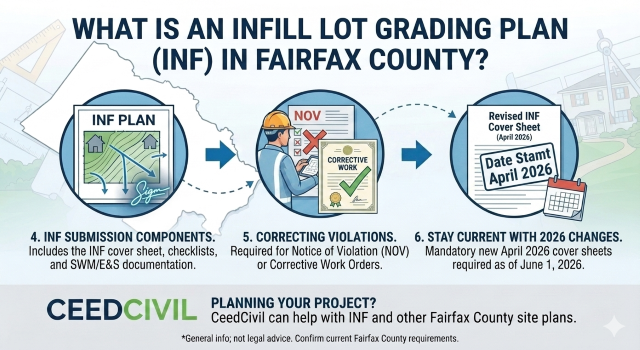
what is an infill lot grading plan (inf) in fairfax county?
If you’re building or improving a single-family home on an existing lot in Fairfax County, you may eventually hear the term INF plan.
INF stands for Infill Lot Grading Plan.
It is one of the site-related plan types used by Fairfax County Land Development Services, and knowing when it applies can save a property owner a lot of confusion during the permitting and construction process.
What is an inf plan?
An Infill Lot Grading Plan is used for certain residential development projects involving an existing lot.
According to Fairfax County, an INF is required for non-bonded single-family residential construction when the project will disturb more than 2,500 square feet of land and includes stormwater management improvements.
That definition is important because the need for an INF isn’t determined simply by whether you’re building a house.
The proposed work and site conditions matter.
why does fairfax county require an inf?
Changing a property can change the way water moves across the site.
When a new home, driveway, addition, retaining wall, grading area, or other improvement changes the ground surface, stormwater may no longer follow the same path it did before construction.
An INF helps document the proposed site conditions and grading.
The plan can address items such as grading, drainage, stormwater management, erosion and sediment control, and other site-specific requirements.
what can an inf address?
The exact contents depend on the project, but Fairfax County’s INF submission requirements include items such as:
- INF cover sheet
- Digital signature from the licensed design professional
- Minimum submission checklist
- Stormwater management documentation
- Erosion and sediment control documentation
- Priority Rating Form for E&S inspections
- Applicable Notices of Violation or Corrective Work Orders
- Applicable zoning information
- Other project-specific documentation
This is one reason an INF should not be treated as simply a drawing of where a house will sit.
There are multiple pieces that may need to come together before the plan can move through county review.
what if the property has a notice of violation?
This is particularly important for homeowners dealing with an existing site problem.
Fairfax County’s current INF requirements specifically mention Notices of Violation and Corrective Work Orders when applicable. The county also provides specific requirements for site-related plans submitted to address NOVs.
So if you’re dealing with an existing grading or site violation, don’t assume that the solution is simply to perform the work described verbally by a contractor.
The county may require a formal plan and supporting documentation.
what about the 2500-square-foot threshold?
The 2,500-square-foot threshold comes up frequently in Fairfax County site-development requirements.
But it shouldn’t be used by itself to decide which plan you need.
Fairfax County lists several different site-related plan types, including INF, Conservation Plans, Rough Grading Plans, Subdivision Grading Plans, and Site Plans. The applicable plan depends on the circumstances of the project.
For example, a Conservation Plan can apply to certain residential additions and accessory structures when land disturbance is between 2,500 and 5,000 square feet and stormwater improvements are not required.
That’s why reviewing the entire project is more useful than focusing on one number.
Fairfax County Changed INF Cover Sheet Requirements in 2026
There is another reason property owners and design professionals should make sure they are working from current information.
Fairfax County Land Development Services revised its Site Plan, Public Improvement Plan, Subdivision Plan, and Infill Lot Grading Plan cover sheets in 2026.
The county states that revised cover sheets dated April 2026 must be used for first submissions of applicable SP, PI, SD, and INF plans beginning June 1, 2026. RGPs associated with major plans should also use the revised cover sheets.
Using an outdated form or checklist can create unnecessary corrections.
why professional preparation matters
A grading plan has to reflect the actual property.
That means the professional preparing the plan needs to understand existing site conditions, proposed improvements, drainage patterns, applicable regulations, and the county’s submission requirements.
A plan that looks fine on paper can still create problems if it doesn’t properly address what is happening on the ground.
For Fairfax County homeowners, getting the right plan type at the beginning can help avoid unnecessary back-and-forth during review.
Planning a new home, addition, grading project, or site correction in Fairfax County? CeedCivil can help determine whether an Infill Lot Grading Plan or another site-related plan may be appropriate for your project.
Requirements vary by property and project. Always confirm current Fairfax County requirements before submitting.