
Fairfax County Notice of Violation (NOV): What Should You Do First?
Getting a Notice of Violation from Fairfax County can be stressful, especially when you aren’t sure what caused it or what you’re supposed to do next.
You may have received the NOV because of grading, fill, drainage, land disturbance, construction activity, or another site-related issue.
The worst thing you can do is ignore it.
The second worst thing is to start changing the property again without understanding the violation.
Here’s a practical way to approach the situation.
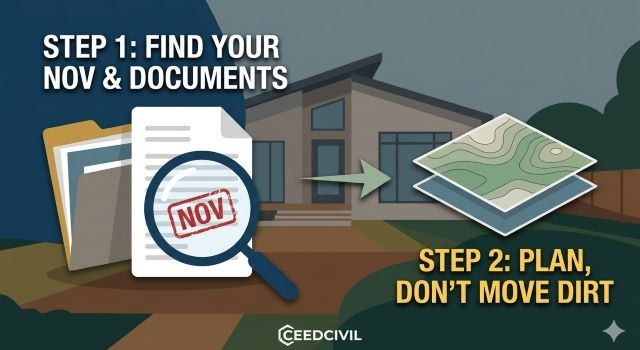
Start With the NOV Itself
Before calling a contractor or moving any soil, read the Notice of Violation carefully.
Fairfax County explains that an NOV generally identifies the violation, the applicable code section, the required corrective action, and a timeframe for compliance.
Those details matter.
The notice should tell you what the county observed and what needs to be addressed.
Don’t Assume the Problem Is Just the Visible Issue
Suppose the NOV says unauthorized grading occurred.
You might look at the property and think:
“Just put the dirt back.”
That may not be the actual solution.
The grading may have changed drainage. The original grade may not be appropriate as the final grade. There may be additional work that needs to be documented.
The visible problem is not always the entire problem.
Determine What Happened
Try to establish what work was performed.
Was soil brought onto the property?
Was soil removed?
Was a backyard graded?
Was a driveway expanded?
Was an addition constructed?
Was drainage changed?
Was a retaining wall installed?
Was the work performed by a contractor?
Gather photographs, invoices, plans, permits, emails, and contractor communications that may help explain the project.
Check Whether There Was an Approved Plan
If you previously had a grading plan or another approved site-development plan, find it.
Compare the approved work with what actually happened.
Sometimes a violation results because work was performed without a required plan.
In other cases, work may have been performed differently from what was approved.
Those are two different situations and may require different corrective steps.
Don’t Move the Dirt Again Without a Plan
This is particularly important with grading violations.
A homeowner may receive an NOV and immediately hire someone to move the soil.
That can create another problem.
Moving soil changes elevations.
Changing elevations can change drainage.
If the county is already concerned about the site’s grading, making another unplanned change can make the situation harder to resolve.
Get the site evaluated first.
Does an NOV Mean You Need an INF?
Not automatically.
An INF, or Infill Lot Grading Plan, is one possible plan type for certain residential projects.
An RGP, Conservation Plan, or another type of approval may be appropriate depending on the property and corrective work.
The NOV itself doesn’t necessarily answer that question.
The site conditions and applicable Fairfax County requirements do.
What If the Violation Involves Drainage?
Drainage-related NOVs deserve special attention.
If runoff is flowing onto a neighboring property, for example, simply changing one elevation may not solve the issue.
The proposed correction should account for where water is coming from and where it will go.
A grading and drainage evaluation can help identify a workable solution.
What If You Didn’t Know a Permit Was Required?
This happens.
A homeowner may have been told by a contractor that no permit was necessary.
Or they may have assumed that backyard grading was ordinary landscaping.
But not knowing about a requirement doesn’t necessarily eliminate the need to correct the site condition.
The useful question now is:
What does Fairfax County require to bring the property into compliance?
That’s where the focus should be.
What Happens Next?
Depending on the violation, the corrective process may involve engineering, a grading plan, physical site corrections, supporting documentation, county review, or some combination of these.
If a plan is required, it should be prepared around the actual site conditions and the requirements identified in the NOV.
Don’t Wait Until the Deadline Is Almost Here
An engineering plan can take time.
So can gathering surveys, reviewing old permits, responding to county comments, and completing physical corrections.
If you’ve received an NOV, start the process early.
The sooner you understand the problem, the more options you generally have for addressing it properly.
Received a Fairfax County NOV involving grading, fill, drainage, or land disturbance? CeedCivil can review the site-related issue and help determine what civil engineering and grading documentation may be needed for the corrective process.
This article is general information, not legal advice. Follow the specific instructions in your NOV and confirm current requirements with Fairfax County.