
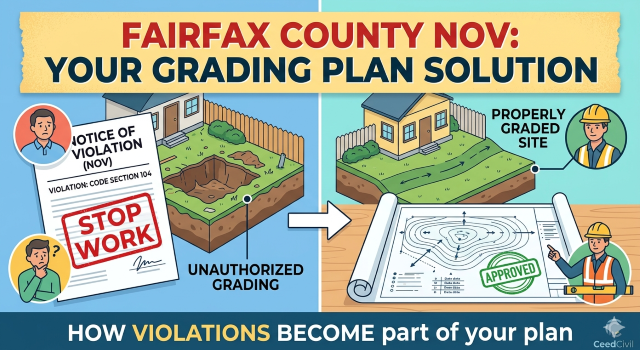
Fairfax County NOV and Grading Plan: How an Existing Violation Can Become Part of Your Plan
Receiving a Fairfax County Notice of Violation is one thing.
Figuring out how to correct it is another.
For some site-related violations, the solution may involve preparing and submitting a grading plan that documents how the property will be brought into compliance.
This is especially relevant when the violation involves unauthorized grading, fill, drainage, or other land-disturbing activity.
What Is an NOV?
A Notice of Violation, or NOV, is the formal notice Fairfax County uses to communicate an observed violation and the corrective action expected.
The county says an NOV typically identifies the type of violation, where and when it was observed, the applicable code section, the required corrective action, and a timeframe for compliance.
That information should become the starting point for determining what happens next.
An NOV Doesn’t Automatically Tell You Which Plan You Need
This is an important distinction.
An NOV might say that unauthorized grading occurred.
It doesn’t necessarily mean the answer is automatically an INF.
It doesn’t automatically mean an RGP either.
The appropriate plan depends on the actual site, the existing conditions, the proposed corrective work, the amount of disturbance, and the applicable county requirements.
Fairfax County maintains separate requirements for INF and RGP submissions.
The Violation May Need to Be Included in the Plan
This is where the connection between an NOV and a grading plan becomes particularly important.
Fairfax County’s current INF checklist requires applicants to indicate whether there is a Notice of Violation and, if there is one, identify the sheet where a copy of the violation is included in the plan.
The current RGP requirements similarly state that applicable Notices of Violation and Corrective Work Orders should be included with the plan.
In other words, an existing violation isn’t necessarily something that sits separately from the engineering submission.
It can become part of the plan-review process.
What Does the Engineer Need to Understand?
Before preparing a corrective grading plan, the professional working on the project needs to understand what actually happened.
For example:
Was soil added?
Was soil removed?
Was the property regraded?
Was a drainage swale changed?
Was construction performed outside the approved limits?
Did runoff change?
Was land disturbed without the required approval?
These questions matter because the plan needs to reflect the existing site and the proposed correction.
Why “Just Put It Back” Isn’t Always Simple
Suppose a homeowner added several truckloads of fill to create a level backyard.
Fairfax County issues an NOV.
The homeowner thinks the answer is simply to remove the dirt.
But how much dirt?
Where should the final elevation be?
Where should stormwater go?
Does removing the fill create erosion?
Does the correction affect an existing drainage feature?
A proper site evaluation can answer those questions before heavy equipment is brought back onto the property.
What If the Violation Involves Drainage?
Drainage can make a corrective project more complicated.
Changing the grade may solve standing water in one location while sending runoff somewhere else.
That’s why a corrective grading plan should not be treated as a simple drawing exercise.
The proposed grades need to make sense with the surrounding property and drainage conditions.
What Happens After Submission?
Fairfax County reviews site-related plans for completeness and compliance with applicable codes and ordinances.
For INF plans, the county says the review can involve the Site Application Center, Minimum Submission Review Team, Health Department when applicable, and Site Development and Inspections Division. Applicants can receive deficiencies requiring corrections, additional documents, and potentially resubmission fees.
RGP submissions have a similar correction process, including responses to open issues through the PLUS Digital Plan Room.
So preparing the first submission correctly matters.
The Goal Is Compliance, Not Just a New Drawing
When a grading plan is being prepared because of an NOV, the purpose isn’t simply to create paperwork.
The plan should show how the site will address the underlying issue and satisfy the applicable county requirements.
If you have received an NOV involving grading, fill, drainage, or land disturbance, don’t start changing the property again without understanding what Fairfax County expects.
CeedCivil can help property owners evaluate site violations and prepare the civil engineering and grading documentation needed to address applicable Fairfax County requirements.
An NOV can involve legal and regulatory requirements. Always follow the specific instructions in your notice and consult the appropriate Fairfax County official regarding compliance