
Fairfax County Rough Grading Plan (RGP): When Is One Required?
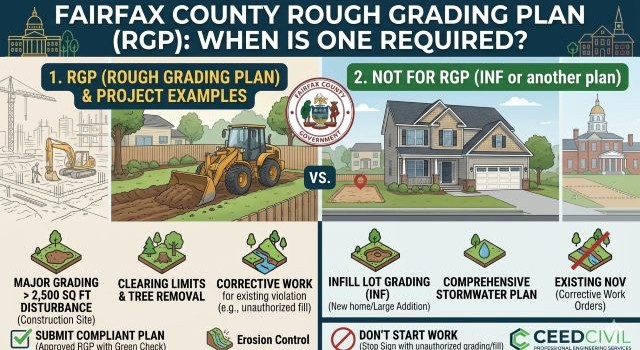
If you’re planning major grading or clearing work in Fairfax County, you may come across the term RGP, or Rough Grading Plan.
For homeowners and property owners, the terminology can be confusing. An RGP isn’t simply a drawing showing where dirt should be moved. It is a site-development plan used for certain projects where clearing and grading need to be reviewed and approved.
Understanding when an RGP may be required can prevent you from beginning work before you have the necessary approvals in place.
What Is a Rough Grading Plan?
A Rough Grading Plan shows the proposed grading of a property.
It can document things such as existing and proposed elevations, limits of clearing and grading, drainage features, erosion and sediment controls, and other site improvements that apply to the project.
Fairfax County’s Land Development Services identifies the RGP as a plan type used for certain projects involving clearing and grading. The county’s requirements should be checked based on the specific project before work begins.
When Can an RGP Be Required?
Fairfax County states that an RGP is required for certain projects when the proposed clearing and grading is not shown on another applicable plan.
One important threshold is 2,500 square feet of land disturbance.
The county states that land-disturbing activity equal to or greater than 2,500 square feet may require an approved plan and land disturbance permit before work starts.
But the amount of disturbance isn’t the only consideration.
The type of project and other site conditions matter too.
Don’t Confuse RGP With an INF
This is a common source of confusion.
Both INF and RGP plans can involve grading, but they aren’t interchangeable.
An Infill Lot Grading Plan (INF) is generally associated with certain single-family residential construction projects and specific stormwater requirements.
An RGP is used in different circumstances, including projects where the proposed clearing and grading isn’t shown on another applicable plan.
So if someone tells you, “You need a grading plan,” the next question should be:
Which grading plan?
That answer should come from the actual project requirements.
What Can an RGP Address?
Depending on the project, an RGP can be used to document proposed site conditions involving:
- Existing and proposed grades
- Clearing limits
- Grading limits
- Drainage
- Stormwater
- Erosion and sediment control
- Retaining walls or other site features
- Corrective work associated with an existing violation
The exact requirements depend on the project.
What If There Is Already a Notice of Violation?
An RGP can become particularly important when unauthorized grading or land disturbance has already occurred.
Fairfax County’s RGP requirements provide for Notices of Violation and Corrective Work Orders to be included with the plan when applicable.
That means the RGP may become part of the process for bringing an existing site condition into compliance.
For example, suppose a property owner added fill and regraded a large portion of the backyard without obtaining the required approval.
If the county issues an NOV, simply removing a little dirt may not be enough.
The existing conditions may need to be evaluated, and a corrective grading solution may need to be developed.
What Fairfax County Reviews
The county’s review can involve several aspects of the proposed work.
The reviewers may have to decide if the plan: Accurately depicts the site Complies with applicable grading requirements Tackles drainage Erosion and sediment control measures required were Meets storm water requirements Precisely describes the current situation Addresses any applicable NOV/corrective work* A plan without the information that is important may lead to review comments and subsequent work.
What Happens After You Submit an RGP?
The county reviews the submission and may issue comments or deficiencies.
The design professional may then need to revise the drawings and provide responses before the plan can move forward.
This is one reason it is worth preparing the plan carefully the first time.
A rushed submission can lead to multiple correction cycles.
Should You Start Grading Before the RGP Is Approved?
No.
If your project requires an approved grading plan, don’t assume that you can begin clearing or moving soil while the plan is being reviewed.
Fairfax County specifically warns property owners about beginning land-disturbing activities without the required approval.
That can turn a normal construction project into an NOV.
Planning an RGP in Fairfax County?
If you’re preparing for substantial grading, clearing, drainage work, or corrective work, the first step is determining what type of plan applies to your property.
CeedCivil can help evaluate the proposed work, review existing site conditions, and prepare the civil engineering documentation required for applicable Fairfax County grading and site-development approvals.
Requirements vary by project and property. Always confirm the current Fairfax County requirements before beginning land-disturbing activity.