
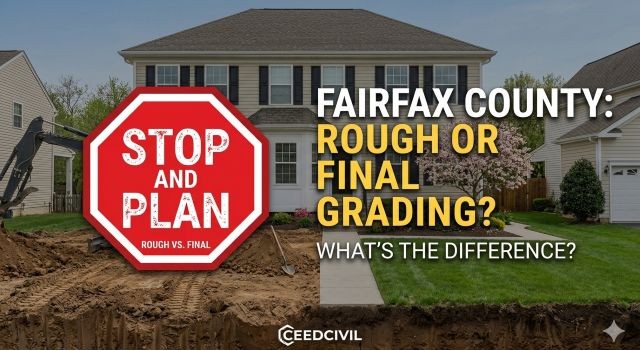
Fairfax County Rough Grading Plan vs. Final Grading: What’s the Difference?
If you’ve been dealing with Fairfax County grading requirements, you may have heard two terms that sound almost identical:
Rough grading and final grading.
They aren’t the same thing.
Understanding the difference is useful for property owners, builders, and anyone dealing with a grading plan or site violation.
What Is Rough Grading?
Rough grading establishes the basic shape and elevations of the site.
It generally happens before the final surface improvements are completed.
Think of it as getting the site to its designed underlying elevations.
Major earthwork may include:
- Cutting soil
- Placing fill
- Creating slopes
- Establishing drainage paths
- Preparing building areas
- Forming other major site grades
The exact scope depends on the project.
What Is Final Grading?
Final grading is the finished condition of the site.
It can include the final surface elevations and preparation for improvements such as landscaping, pavement, lawns, and other site finishes.
The final condition should tie into the approved design.
A property shouldn’t be left with a rough grade that creates drainage problems simply because the final landscaping hasn’t been installed yet.
Why Does the Difference Matter?
Because changing the rough grade can affect everything that comes afterward.
If the underlying grade is wrong, the finished grade may also be wrong.
For example, suppose the rough grade sends water toward a house.
Adding grass doesn’t solve the problem.
The underlying drainage needs to be corrected.
What Is an RGP?
RGP stands for Rough Grading Plan.
Fairfax County uses RGPs for applicable projects involving clearing and grading when the work isn’t shown on another appropriate plan.
The plan documents the proposed grading and other applicable site-development information.
It is not simply a contractor’s dirt-moving sketch.
Can a Homeowner Change the Rough Grade After Approval?
Don’t assume you can.
If the change affects the approved grading or drainage, it may need to be reviewed.
For example, adding several inches or feet of fill can change the property’s elevations and runoff.
That may create a condition different from what Fairfax County approved.
What If the Contractor Says the Site Needs More Dirt?
Ask why.
Maybe the contractor encountered an unexpected site condition.
Maybe the elevation at the foundation is different from what was anticipated.
Maybe the homeowner wants a flatter yard.
Whatever the reason, the change should be reviewed before significant additional grading takes place.
What If the Rough Grade Has Already Been Changed?
If the property has already been graded differently from the approved plan, document the current condition.
Take photographs.
Gather the approved plans.
Record what work was performed.
Then have the site evaluated.
If Fairfax County has issued an NOV, provide the notice as well.
Why Existing Elevations Matter
A corrective grading plan needs to show where the property is now.
You cannot design a useful correction based only on where the property was supposed to be.
That is especially important when unauthorized grading has already occurred.
The current site may be different from the approved design.
What Happens When the Site Is Ready for Final Grading?
The final grading should follow the approved design and maintain appropriate drainage.
The finished elevations should work with the house, driveway, sidewalks, neighboring properties, and other site features.
If something has changed during construction, address it before the final work is completed.
Don’t Treat Grading as Just Moving Dirt
This is the mistake that causes many problems.
Grading determines elevation.
Elevation determines water flow.
Water flow can affect drainage, erosion, structures, and neighboring properties.
That’s why Fairfax County grading requirements deserve attention before the equipment arrives.
Need an RGP, corrective grading plan, or help resolving a Fairfax County grading issue? CeedCivil can evaluate the project and provide the civil engineering support needed for applicable county requirements.
Specific plan and approval requirements vary by project. Confirm current requirements with Fairfax County before beginning grading work.