
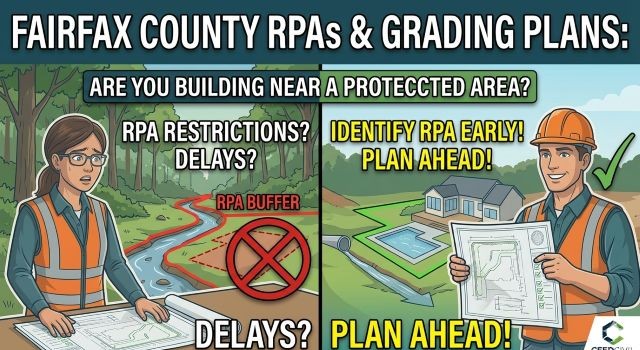
Fairfax County RPA and Grading Plans: Can an Environmental Restriction Affect Your Project?
You’re planning an addition, pool, driveway, or grading project in Fairfax County.
You have the architectural plans.
You may even have a survey.
Then you hear another term:
RPA.
An RPA, or Resource Protection Area, can affect how a property is developed and what can be done with the land.
That makes it something to investigate before finalizing a grading plan.
What Is an RPA?
A Resource Protection Area is an environmentally sensitive area regulated under Fairfax County’s Chesapeake Bay Preservation requirements.
RPAs are generally associated with protecting streams, water resources, and sensitive areas.
The important point for a property owner is that an RPA can affect proposed land disturbance and development.
Why Does This Matter for a Grading Plan?
Grading changes the land.
If your proposed work extends into or near a regulated area, the grading design may need to account for additional requirements.
Fairfax County specifically lists Resource Protection Areas (RPA) among the site conditions applicants should investigate before submitting site-related plans.
That means RPA status shouldn’t be discovered after the grading plan is already finished.
What Projects Can Be Affected?
Potentially many types of property improvements can involve grading.
For example:
A home addition.
A detached garage.
A swimming pool.
A driveway.
A retaining wall.
A large patio.
A regrading project.
The actual effect depends on where the proposed work is located and what environmental restrictions apply.
Don’t Assume the Backyard Is Unrestricted
A homeowner may think:
“The RPA is somewhere near the creek, and my addition is farther away.”
That may be true.
But the exact property conditions need to be checked.
The location of the proposed construction, drainage patterns, property features, and applicable boundaries all matter.
What Should You Check Before Designing?
Before finalizing your grading plan, review:
Property boundaries.
Existing topography.
Drainage.
Floodplain information.
RPA information.
Existing structures.
Proposed improvements.
Soil conditions.
Previous site plans.
Fairfax County’s Plan Ahead guidance specifically recommends researching these types of conditions before submitting a site-related plan.
Can an RPA Affect an INF?
Potentially.
An INF is not simply a drawing showing where the new house or addition will go.
Fairfax County’s current INF guidance tells applicants to consider environmental and site conditions including floodplains and RPAs.
So if you’re preparing an INF, environmental restrictions should be considered as part of the early site review.
What About a Conservation Plan?
The same principle applies.
Fairfax County’s Conservation Plan guidance lists RPAs, floodplains, grading/site plans, soils, and other site conditions among the items applicants should consider before submission.
A small project can still have complicated site conditions.
What If the Project Is Near a Stream?
Pay particular attention.
Drainage and environmental requirements can become more important when work is close to streams or other protected resources.
Don’t wait until construction starts to find out whether the proposed grading affects a regulated area.
What If You Already Have a Grading Violation?
An RPA or environmental restriction can be relevant when developing a corrective plan as well.
If Fairfax County has issued an NOV, provide the notice and any existing site documents to the design professional.
The corrective solution needs to address both the violation and the applicable site requirements.
Can You Just Move the Project Somewhere Else?
Sometimes changing the location of an addition, pool, or other improvement can help.
But that decision should be made during design, not after construction begins.
Moving the structure can affect setbacks, grading, drainage, utilities, access, and other requirements.
Check Before You Draw
One of the easiest ways to avoid a redesign is to identify site constraints early.
A grading plan should be based on the actual property, not just the proposed building footprint.
Planning a Fairfax County addition, pool, garage, or grading project near an RPA or other environmentally sensitive area? CeedCivil can review the site conditions and help incorporate applicable grading and civil engineering requirements into the project.
Environmental and land-development requirements vary by property. Confirm the current Fairfax County requirements for your specific site.