
Fairfax County Site Violation: What Happens After Someone Complains About Your Property?
Sometimes a property owner doesn’t realize there is a problem until the county gets involved.
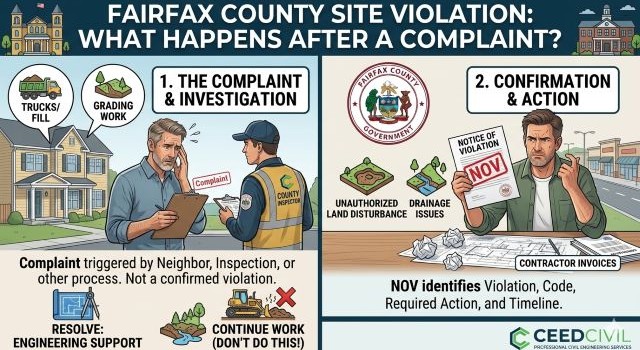
Maybe a neighbor noticed trucks bringing in fill.
Maybe runoff started crossing a property line.
Maybe someone saw grading work taking place.
A complaint can lead Fairfax County to investigate a possible site violation.
That doesn’t necessarily mean the property owner did something wrong.
But if the county identifies a violation, you’ll need to understand what happens next.
How Does a Site Violation Start?
There are several ways a potential violation could come to the county’s attention.
A complaint is one possibility.
County staff may also observe work during an inspection or identify an issue through another county process.
The important thing is what the investigation finds.
A complaint itself is not the same thing as a confirmed violation.
What Does Fairfax County Look At?
For grading and land-disturbance issues, the county may need to determine what work occurred and whether the necessary approvals were obtained.
That can include questions about:
- Clearing
- Grading
- Fill
- Excavation
- Drainage
- Stormwater
- Approved plans
- Land disturbance
The actual site conditions matter.
What If the Work Was Done by a Contractor?
The homeowner may say:
“My contractor handled everything.”
That may explain who performed the work, but it doesn’t automatically resolve the site issue.
If unauthorized grading or land disturbance occurred, the property may still need corrective action.
This is why homeowners should keep copies of permits, plans, contractor communications, invoices, photographs, and other project records.
What Is a Notice of Violation?
If Fairfax County determines that a violation exists, it may issue a Notice of Violation.
The county says an NOV generally identifies the violation, the applicable code provision, the required corrective action, and a timeframe for compliance.
Read the notice carefully.
Don’t focus only on the deadline.
The description of the violation tells you what needs to be addressed.
What If the Violation Involves Grading?
This is where civil engineering may become necessary.
If the site has been altered, someone may need to determine:
What are the existing elevations?
What were the original or approved grades?
How has drainage changed?
What should the final grades be?
Is a grading plan required?
Does the corrective work need stormwater or erosion controls?
The answers depend on the property.
What If the County Requires an INF or RGP?
The appropriate plan depends on the site and corrective work.
An INF may apply to certain residential projects.
An RGP may apply to other grading and clearing situations.
Fairfax County’s current requirements specifically account for plans submitted in connection with Notices of Violation and Corrective Work Orders when applicable.
The NOV therefore needs to be considered when preparing the plan.
Don’t Make More Changes Before Understanding the Violation
This is one of the most important things a property owner can do.
If the county says your grading is unauthorized, don’t immediately bring in more fill.
If drainage is the issue, don’t dig a new ditch without understanding where the water will go.
If soil was placed improperly, don’t simply move it to another part of the yard.
You could create another site condition that also needs to be corrected.
What Documentation Should You Gather?
Before meeting with an engineer, collect whatever information you have.
Useful documents can include:
- The Notice of Violation
- Previous grading plans
- Site plans
- Surveys
- Building permits
- Contractor invoices
- Construction photographs
- Emails or text messages about the work
- Information about where soil came from
- Drainage photographs
The more information available, the easier it is to understand what happened.
Can a Site Violation Be Resolved?
Many site violations can be addressed through the appropriate corrective process.
But the exact solution depends on the violation.
Sometimes the work needs to be corrected physically.
Sometimes documentation or an approved plan is required.
Sometimes both are needed.
The first step is understanding what Fairfax County is asking you to correct.
Received a Fairfax County site violation or NOV involving grading, fill, drainage, or land disturbance? CeedCivil can help evaluate the existing site conditions and determine what civil engineering and grading-plan support may be appropriate.
This article provides general information and is not legal advice. Follow the specific instructions in your Notice of Violation and confirm requirements with Fairfax County.