
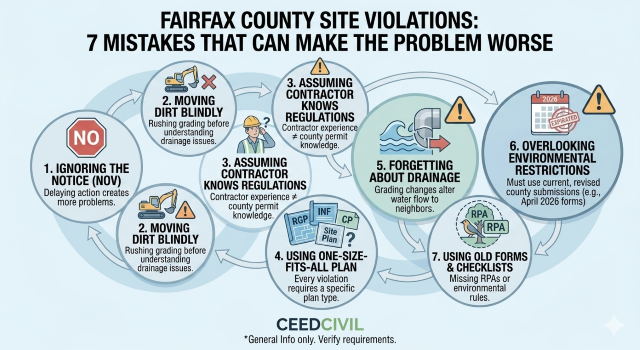
fairfax county site violations: 7 mistakes that can make the problem worse
A Fairfax County site violation can start with something that seems minor.
Maybe fill dirt was brought onto a property. Maybe a contractor changed the grade around a house. Maybe a driveway, retaining wall, addition, or other improvement changed the way water moves across the lot.
Then a notice arrives.
For a property owner, the first reaction is often to fix the problem as quickly as possible. That makes sense, but rushing into corrective work can sometimes create additional problems.
Fairfax County regulates land disturbance, grading, fill, erosion, and stormwater. The county states that disturbing 2,500 square feet or more without an approved plan can result in a violation. It also warns that accepting fill dirt without an approved grading plan can put a property owner in violation of environmental requirements.
Here are seven mistakes worth avoiding.
1. ignoring the notice of violation
An NOV should not sit in a drawer while you figure out what to do.
The notice identifies the violation and provides information about the corrective action. The sooner you understand what the county is asking for, the more time you have to determine how to address it.
Waiting until the deadline is close can make the process harder.
2. moving more dirt before understanding the problem
This happens more often than people realize.
A homeowner sees standing water and thinks the answer is to bring in soil. Another property owner sees runoff going toward the house and decides to change the slope.
But grading changes water flow.
Adding or removing soil without first understanding the existing elevations can move the problem somewhere else. It may also create a new drainage issue for a neighboring property.
Before changing the grade, determine what is actually causing the problem.
3. assuming the contractor knows what fairfax county requries
A contractor may be very experienced at excavation, grading, landscaping, or construction.
That doesn’t automatically mean the contractor is responsible for determining which Fairfax County site-related plan is required.
Fairfax County has several plan types, including Infill Lot Grading Plans, Conservation Plans, Rough Grading Plans, Site Plans, and other site-related plans. The appropriate plan depends on the project and its circumstances.
The plan type should be determined before work starts, not after a violation occurs.
4. assuming every grading violation needs the same plan
There isn’t one universal “grading violation plan.”
For example, Fairfax County says an Infill Lot Grading Plan is required for certain non-bonded single-family residential construction disturbing more than 2,500 square feet when stormwater management improvements are included.
A Conservation Plan has different criteria. It is used for certain residential additions and accessory structures when land disturbance is between 2,500 and 5,000 square feet and stormwater improvements are not required.
An RGP is another separate plan type.
The correct answer depends on the actual site and proposed corrective work.
5. forgetting about drainage
A site violation isn’t always about where the dirt is.
It’s also about where the water goes.
A grading change can alter drainage patterns, concentrate runoff, or affect neighboring properties. Certain INF projects may also require drainage studies, depending on site conditions. Fairfax County’s current INF cover sheet instructions identify circumstances involving open drainage swales and drainage areas where a drainage study may be required.
That’s why elevations and drainage should be considered together.
6. overlooking environmental restrictions
Some Fairfax County properties have additional considerations.
For example, a property may be located in or near a Resource Protection Area.
Fairfax County states that RPA boundary delineation studies or RPA plans are required for site-related plans where RPAs are shown on the adopted county map, including INF and RGP projects.
A property owner who only looks at the grading issue may miss an environmental requirement that affects the proposed solution.
7. using old county forms or checklists
This is an easy one to overlook.
Fairfax County revised several site-development cover sheets in 2026. The county states that revised April 2026 cover sheets must be used for first submissions of applicable SP, PI, SD, and INF plans beginning June 1, 2026.
The county also maintains current minimum-submission checklists for different plan types.
If you’re preparing a submission, don’t simply pull an old PDF from a previous project and assume it is still current.
What Should You Do If You Already Have a Site Violation?
Start with the actual notice and the property.
Determine what the county says is wrong. Then look at the existing site conditions and identify what corrective work is actually needed.
If the issue involves grading, drainage, stormwater, land disturbance, or another engineering-related condition, a civil engineering review can help determine the appropriate next step.
The goal isn’t simply to make the site look different.
The goal is to correct the underlying issue in a way that addresses the county’s requirements.
If you’ve received a Fairfax County Notice of Violation involving grading, drainage, land disturbance, or site work, CeedCivil can help evaluate the situation and determine what engineering and plan support may be needed.
County requirements vary by project and property. Confirm current Fairfax County requirements before beginning corrective work.